

The Short Answer
Autonomous security covers the repeatable portion of an overnight post. That includes the patrol loop, continuous observation between fixed camera positions, the first challenge when something moves, and the documentation that follows. The officer keeps the work that depends on judgment, authority, and physical presence.
The practical question is which overnight work is manual and repeatable enough to run on its own, and what that frees an officer to do instead. On most sites, the result is better coverage on a post that’s currently thin, unfilled, or held together with overtime.
Why the Overnight Post Is Hard to Fill and Harder to Keep Covered
Turnover, overtime, call-offs, and no-show backfill all concentrate on the overnight shift. It’s the post scheduled last and the one most likely to go uncovered when someone doesn’t show. Supervision is thinnest at the same hours an officer is most likely to need help verifying an alarm, reaching the right stakeholder, or deciding whether to dispatch.
Many overnight alarms don’t become security incidents. Wildlife, weather, shifting light, authorized deliveries, and maintenance can all create activity. Treating every trigger alike creates false alarm fatigue, and confidence in the system begins to fall.
AI detection signals that a defined event may have occurred. Security response determines whether it matters, what action should follow, and whether the situation reached resolution. Recorded video may answer what happened by morning. Overnight operations need verification and response while the activity is still in progress.
Which Overnight Work Is Manual and Which Can Run Autonomously
The U.S. Bureau of Labor Statistics describes guard duties that include patrolling property, monitoring alarms and video, deterring criminal activity, controlling access, responding to emergencies, and writing reports. Walk through a typical overnight post and the work generally includes:
- Maintaining a visible presence and deterring unwanted activity
- Patrolling assigned routes and observing changing conditions
- Verifying alarms against cameras, access events, and site context
- Escalating incidents and notifying site contacts or responders
- Issuing a voice challenge and assessing the reaction
- Performing lockup checks, escorts, first aid, or physical intervention
- Documenting activity, actions, and outcomes for the next shift
Most of that list is structured and repeatable. Routine patrol, continuous observation, initial verification, voice deterrence, escalation, and incident documentation follow the same steps every night, and they consume the majority of an overnight shift while producing an incident on very few of them.
Locking a door, escorting an employee, providing first aid, inspecting damage, de-escalating a person on site, or intervening directly requires an officer. So does any decision where the consequence of getting it wrong belongs to a guard. Keeping that line clear is what makes it possible to redesign the post around the work each side does well.
What Autonomous Security Covers
Covering an overnight post means separating patrol, fixed detection and deterrence, and incident response orchestration, then assigning each to the right part of the system.
Physical AI for Mobile Patrol
Physical AI refers to autonomous machines that perceive, decide, and act in the physical world. For security patrols, that means a mobile system moving through the property while sensing and responding to its environment. The distinction matters during evaluation. A camera may run AI analytics, pan, tilt, or sit on a relocatable trailer. It remains Edge AI because it operates from a fixed position. Being relocatable isn’t autonomous movement.
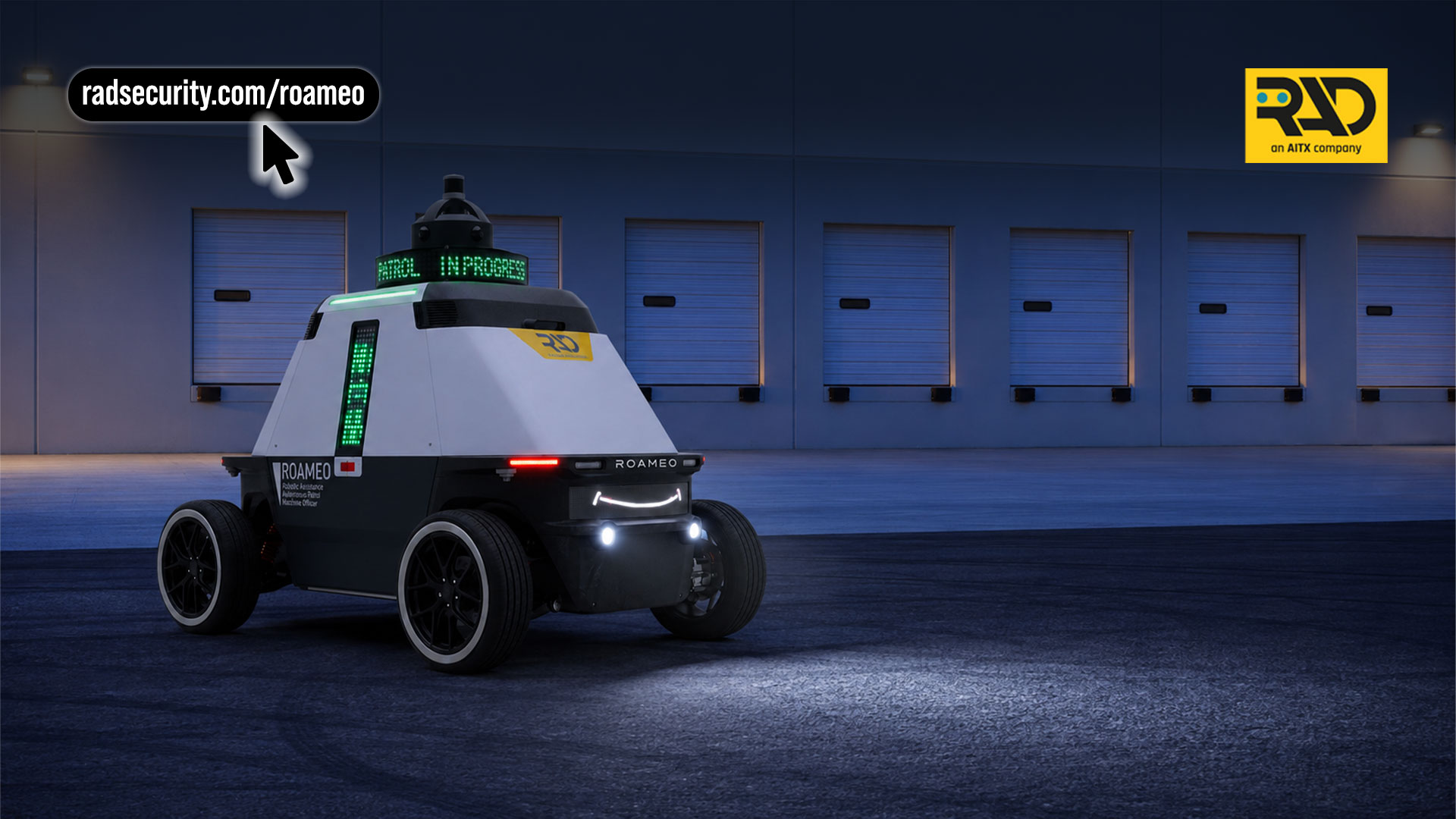
ROAMEO is a Physical AI security patrol robot. It moves autonomously through assigned outdoor routes with 360-degree AI detection, visible presence, and audio and visual deterrence. The route runs consistently through the full operating window, without being interrupted by other incidents or staffing changes.
“A camera can detect activity from one position. Physical AI carries detection through the property, providing a mobile presence where fixed cameras can’t reach.”
Steve Reinharz, Founder and CEO, Robotic Assistance Devices
Like any mobile patrol, ROAMEO doesn’t observe every part of a large property at once. Its advantage is consistent route execution and continuous AI observation while moving. Fixed coverage remains at higher-risk locations, so detection doesn’t depend on the next patrol loop.
Edge AI at Fixed Positions
ROSA, RIO, and AVA apply Edge AI where fixed coverage matters. ROSA detects activity and delivers audio and visual deterrence from a wall or pole. RIO provides rapidly deployable 180-degree or 360-degree coverage. AVA verifies credentials, detects tailgating, and manages gate activity.
These devices detect and act at the point of the event. AI deterrence delivered on site removes the delay created when raw video or a basic alarm must wait in a remote guarding queue before anyone can issue a challenge.
Agentic AI for Incident Response Orchestration
SARA Agentic AI provides the operator layer across fixed and mobile security. When AI detection identifies an event, SARA verifies the activity, applies the site’s escalation path, initiates a voice-down, notifies the right stakeholders, and continues monitoring the scene.
That's security incident response orchestration: coordinating the steps from detection to resolution instead of leaving each one for an operator to complete manually. Remote guarding becomes exception-based, and officers enter the workflow when the incident, policy, or consequence requires judgment.
What Officers Keep
The manual effort moves away from watching and waiting. It moves toward resolving the smaller number of incidents that require human authority or physical action.
A remote operator can oversee multiple sites and work verified exceptions instead of continuously watching screens. On site, officers stay responsible for first aid, escorts, access decisions, hands-on intervention, de-escalation, and coordination with public safety. Those are the posts worth staffing and the assignments officers are more likely to stay in.
What This Means for Guard Companies, Dealers, and Integrators
The staffing shortage on overnight posts is a business problem before it’s a security one. A provider that can’t fill a shift is paying overtime, absorbing backfill, or explaining an uncovered post to the customer at renewal.
Autonomous security gives them a way to answer a hard renewal question: how to expand coverage without adding patrol hours they can’t hire for. Routine routes and continuous observation run on their own while officers hold the posts and incidents where their presence matters. The account keeps its coverage, the provider keeps its margin, and the hours that were hardest to staff stop being the weak point in the contract.
It also changes what a provider can sell. Coverage between fixed camera positions, verified response at the moment of detection, and documented incident handling are services a guard schedule alone can’t deliver.
How to Model the Cost of Covering an Overnight Post
Start with what the post costs today. For contracted guarding, the security guard cost is the bill rate multiplied by posted hours, nights per year, and posts. Determine what the rate includes before adding overtime, holiday premiums, supervision, retraining, and no-show coverage. For an in-house team, include wages, payroll costs, benefits, workers’ compensation, equipment, training, and management time.
Add the cost of the hours you aren’t covering. Uncovered shifts, shortened patrol loops, and posts filled by whoever was available carry real exposure that rarely appears on an invoice.
Next, model coverage. Measure how many priority zones are observed each hour, how long they remain unobserved, and how quickly an event can be verified and challenged. Acreage alone doesn’t answer that question. A 40-acre site with four concentrated risk areas may require a different deployment than a smaller property with a long perimeter and several entrances.
Autonomous deployment costs move with site size, route length, terrain, fixed detection points, connectivity, existing camera and access-control integrations, operating schedule, and the response path. Map those requirements before comparing models.
The useful comparison is cost per verified, resolved incident. Cost per hour says what coverage consumes. Cost per resolution shows what the security program accomplishes.
How to Measure ROI in the First 90 Days
Establish the baseline before the deployment starts, then measure the same operating outcomes at 30, 60, and 90 days:
- Time from detection to verified response
- Ratio of verified incidents to unverified alarms
- Incidents resolved without a physical dispatch
- Deterrence events that ended following the initial challenge
- Observed coverage hours across each priority zone per night
Also track overtime, no-show backfill, missed patrols, and officer hours reallocated to staffed posts. Those numbers show whether the model improved security performance and labor predictability at the same time.
Bottom Line
Start with one overnight post where most of the shift is spent patrolling, observing, and handling alarms. Map every duty, the time it consumes, and whether it needs an officer’s judgment or physical presence. What’s left is the repeatable work, and that’s the scope for a pilot and the baseline for its first 90-day review.
See how RAD can help redesign overnight security coverage. Request a demo.