

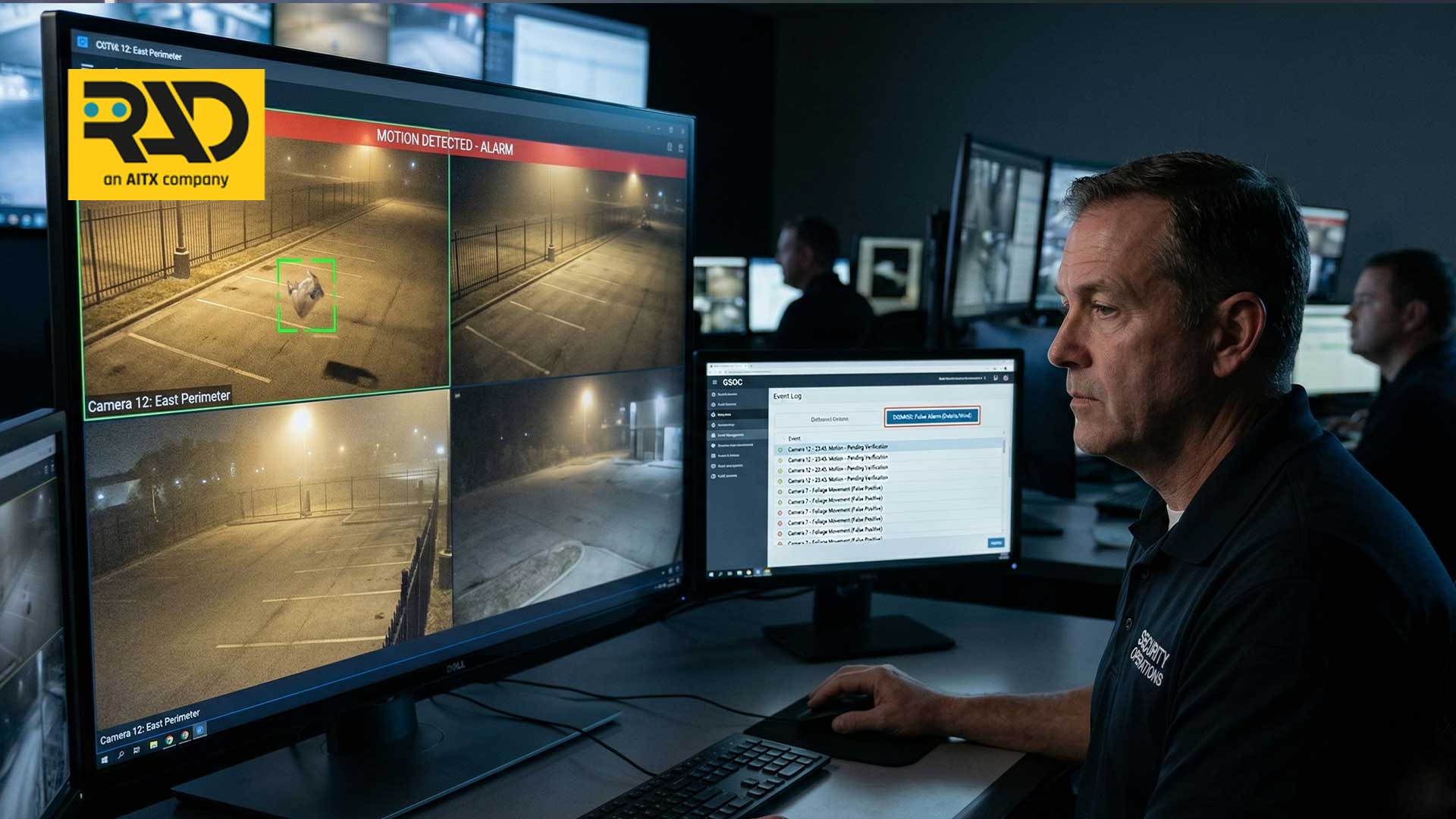
False Alarm Fatigue Is More Than an Annoyance
A high alert count does more than clutter the screen. It changes how people work.
When most alerts turn out to be harmless, operators begin to expect the next one will be harmless too. That lowers urgency and trust in the system. Over time, review becomes repetitive and response becomes slower.
This creates real operational risk. A security team should not have to spend most of its time checking events that go nowhere. But that is what happens when alerts lack context and every event enters the same review process. Time gets burned on motion events, after-hours activity that is not a threat, routine traffic patterns, or site activity that should never have required escalation in the first place.
False alarm fatigue is what happens when the system asks people to do too much work for too little value.
Why False Alarms Keep Happening
False alarms do not come from one issue alone. They usually come from several.
Some alerts are triggered by basic motion or activity rules that do not provide enough context. Movement was detected, but that does not tell the operator whether a person is crossing a lot, loitering near a door, approaching a fence line, or entering a restricted area after hours.
Some alerts come from fragmented workflows. One platform detects. Another records. Another sends notifications. Another stores logs. The operator has to connect the pieces.
Some alerts come from rules that identify activity without helping determine whether it matters. A system may be able to detect motion, vehicles, or human presence, but still leave the hard part to the operator.
The larger problem comes after detection.
If every alert must be reviewed, verified, escalated, and documented by hand, the burden builds fast. Even harmless events still take time. That is how false alarm fatigue takes hold.
The Real Cost of False Alarm Fatigue
The first cost is wasted operator time.
But the larger cost is slower response.
When security teams spend too much time sorting through low-confidence events, real incidents wait in line with everything else. That increases review burden, delays escalation, and stretches the window between detection and action.
The reporting burden adds more drag. If incident details still have to be pieced together after the event, the workflow stays heavy even when the alert was valid.
This also affects staffing and consistency. Repetitive review work wears people down. Fatigue leads to missed details, slower decisions, and uneven handling from one shift to the next.
Leadership feels the impact too. A platform that generates more activity without reducing operator workload does not strengthen the operation. It adds friction to it.
That is the hidden cost of false alarm fatigue. It is not just noise. It is a daily tax on response performance.
Why Better Detection Alone Doesn’t Solve It
Better detection helps. It is necessary.
It is not enough.
This is where many security conversations go off track. The focus stays on detection accuracy, as if cleaner analytics automatically solve the operational problem. They do not.
A system can improve detections and still leave the team buried if every event follows the same manual process:
Detect. Review. Verify. Notify. Document.
That model does not scale well across more cameras, more sites, or longer hours of coverage. It also does not hold up well when operators are already overloaded.
The real question is not only how well the system detects.
The real question is how much work each alert creates after detection.
If the workflow still depends on people to carry every event from alert to action, false alarm fatigue remains in place.
What an Effective Response Model Looks Like
A better response model reduces review burden and improves how real incidents move through the system.
That starts with higher-confidence event handling. Not every alert should create the same amount of work. The system should help narrow the field before operators are forced into repetitive review.
It also requires automated verification. Operators need context, not just triggers. They need to know what happened, whether it matters, and whether it meets the threshold for escalation.
From there, escalation logic should already be defined. Once an incident reaches the point where action is needed, the response should not depend on ad hoc decisions or disconnected tools.
Documentation should also be built into the workflow. Teams should not have to reconstruct what happened after the fact from scattered notes and saved clips.
That creates a simpler and stronger operating model:
Old model: detect, review, verify, notify, document.
Better model: detect, verify, orchestrate, document.
That shift matters because it reduces manual drag and helps the operation stay consistent.
How AI-Driven Security Should Reduce False Alarm Fatigue
AI-driven security should not be judged by whether it claims zero false alarms.
That is not the real standard.
The better standard is whether it reduces the work created by detection.
A useful system helps teams spend less time reviewing events that do not matter. It improves confidence in the alerts that do. It also helps move valid incidents toward action faster.
That is the difference between detection and response.
Detection identifies possible activity.
Response determines whether the system helps do something useful next.
In physical security, AI should help reduce unnecessary review work, improve verification, support deterrence, and speed up escalation when needed. It should also make incident handling more consistent by reducing the number of steps that still depend on manual coordination.
That is how AI should reduce false alarm fatigue. Not by promising perfection, but by removing avoidable work from the response path.
Where SARA Fits
SARA fits at the point where detection alone stops being enough.
False alarm fatigue stays in place when every alert creates a chain of manual tasks after the event is detected. SARA is designed to reduce that burden by helping handle the operational work that follows detection, including verification support, escalation workflows, notifications, and incident documentation.
That matters because it changes the operator’s role.
Instead of asking teams to manually carry every event from alert to outcome, SARA helps move incidents through a structured response path. It is built to verify, engage, escalate, and document incidents in real time while reducing the manual burden that slows response and adds review waste.
Across the RAD ecosystem, that orchestration can also work with ROSA Edge AI devices and RIO security trailers, which can deliver real-time audio and visual response when rules are met, while SARA adds verified escalation and incident workflow management when deterrence alone is not enough.
That is the practical value.
False alarm fatigue is reduced when the system lowers the manual burden after detection and helps move events toward resolution with fewer delays and fewer handoffs.
What Buyers Should Ask Vendors
Buyers should look past claims about analytics and ask workflow questions.
How are events verified?
What happens automatically after detection?
What still requires human review?
How are incidents documented?
How does the system reduce operator workload instead of just generating more alerts?
Those questions usually reveal the difference between a platform that detects activity and one that helps manage incidents.
From Alert Volume to Incident Handling
False alarms have been normalized for years. That does not mean they should be accepted.
Modern physical security operations need more than alert generation. They need cleaner workflows, better verification, stronger deterrence, and faster escalation.
The goal is not simply better detection.
The goal is better incident handling.
False alarm fatigue is a workflow problem. If the response path is manual, the fatigue stays.
If the workflow is built to verify, orchestrate, and document with less human drag, the operation gets faster, more consistent, and easier to scale.
That is the shift modern security teams should be making now.
Move From Detection to Resolution
False alarm fatigue does not go away when teams get more alerts. It goes away when the response path gets shorter, clearer, and more consistent.
SARA helps security teams move from detection to resolution with less review burden, real-time escalation, and stronger incident handling.