

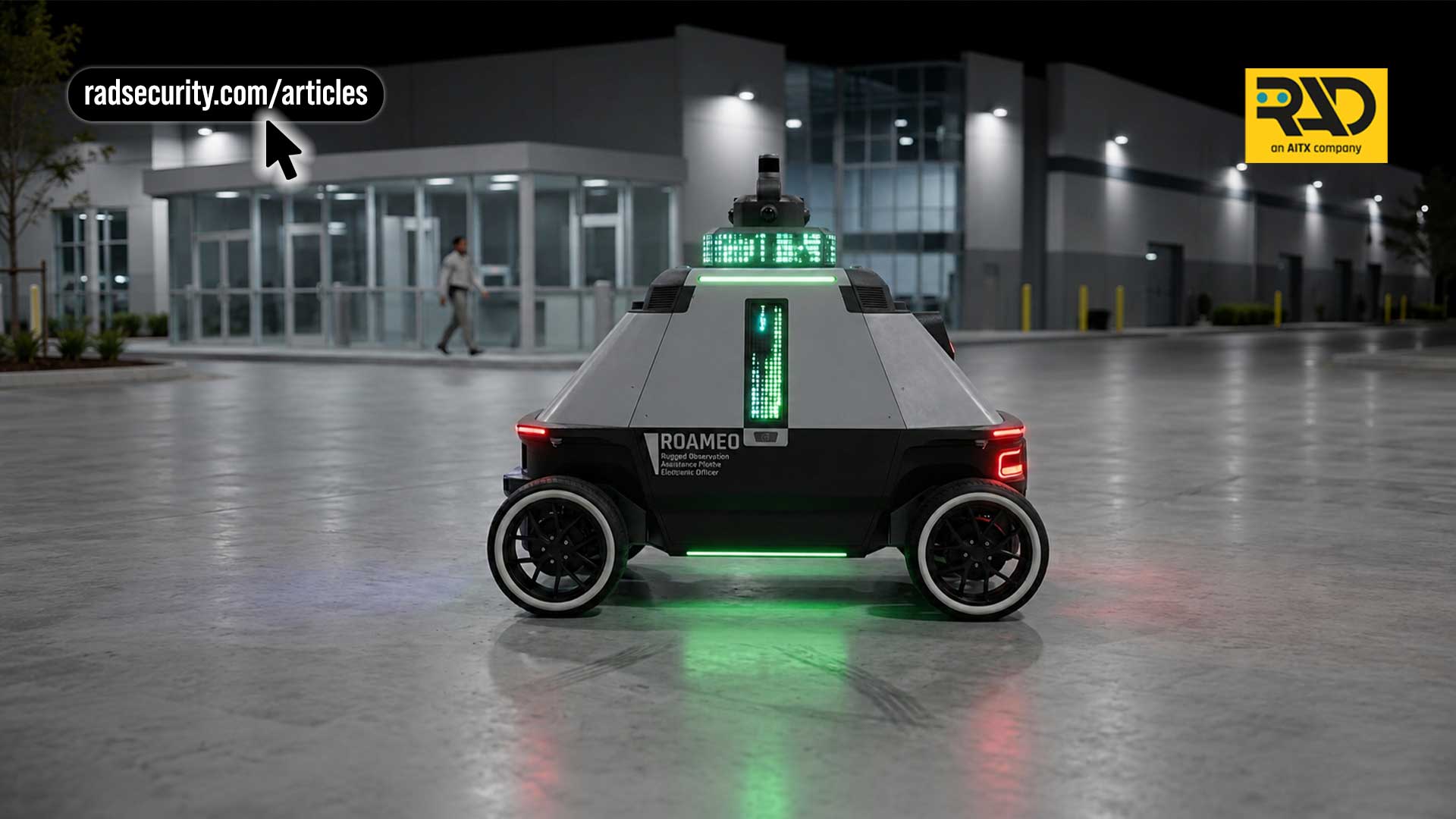
For most of its history, AI in physical security has been a spectator. It lives on a server, watches a camera feed, flags what it sees, and waits for a person to go do something about it. The models got better every year. The analytics got sharper. But the intelligence stayed bolted to the wall, seeing the world from one fixed spot and depending on a human to carry the response to wherever the problem was.
The intelligence never moved.
Physical AI is what happens when it does. It's perception and judgment riding on a platform that travels through a site and acts on what it finds. Two traits define the category. The system drives itself, navigating an entire property without a track or a tether. And it decides what to do about what it sees, which is the trait that separates it from a sensor.
A camera detects. Physical AI detects, decides, and acts in the same motion.
Sensing Isn't Deciding
The term gets used loosely, so it's worth drawing the line precisely. A motion light senses and reacts on a fixed rule. A thermostat senses and adjusts toward a setpoint. A robot vacuum moves through a room without reasoning about anything it encounters. None of that is Physical AI, because none of it involves judgment.
Physical AI sits above that line. It takes in an unstructured situation, weighs what it means, and chooses a response that wasn't scripted in advance. That's a bigger claim than it sounds, because deciding well in an open environment is the part that's been hard for decades. The physical world doesn't hold still or follow rules the way a dataset does. A system operating in it has to handle surprise, ambiguity, and consequences that can't be undone.
Intelligence Moves Closer
There's a long pattern here, and Physical AI is the latest step in it. Computing started locked in a room you booked time on. It moved to the desk, then to the pocket, then to the wrist. Each step put the intelligence nearer to the moment it was needed.
Physical AI is that migration reaching its endpoint. The intelligence goes to the problem. For a field defined by physical space, that's a structural change, because for the entire history of security operations, the intelligence had to wait for a person to be its hands and feet.
Three quiet shifts made it real. Sensors got good enough and cheap enough for a machine to build a reliable picture of a messy, unpredictable environment. Edge compute got fast enough to run that perception onboard, in real time, with no round trip to the cloud. And the reasoning layer arrived. Agentic AI gave these platforms the ability to weigh a situation, choose a response, and speak to a person on scene.
Seeing was solved years ago. Deciding is what just arrived.
A Higher Standard
People expect more from a machine on patrol than from a person walking the same route, and the reason is structural. A human patrol leaves almost no record. When a round runs long, when a sightline goes unchecked, when six quiet hours pass without incident, the program produces no data either way. Coverage is assumed because there's nothing to review.
Physical AI documents every step it takes. Every patrol, every detection, every voice-down interaction, every escalation is timestamped, logged, and reviewable. So the comparison that matters is between an unmeasured program and a measured one, and the measured one carries a standard no security program was ever asked to meet, because it's the first one that can.
That's the scrutiny and the advantage in the same fact. The thing that invites a higher bar is the thing that makes coverage provable. After an incident, a timestamped patrol history and a verified event timeline puts a security leader in a stronger position with an executive team, an insurer, or a courtroom than any account reconstructed from memory.
Hold the system to the data. For the first time in security operations, there's data to hold it to.
On the Ground
ROAMEO is RAD's Physical AI. It patrols outdoor properties on its own, navigating by HD map with five solid-state 3D LiDAR sensors, radar, cameras, GPS, and an IMU fused at the edge. That gives it 360-degree awareness and positioning that holds even where GPS signal is weak. It covers up to 30 miles on a charge, operates from -4°F to 113°F, varies its patrol routes so they can't be learned, and returns to dock and charge on its own schedule.
When it identifies a genuine event, the judgment layer engages. SARA, RAD's agentic AI, speaks to whoever is on scene through voice-down, opens two-way video, escalates to remote operators or dispatch, and documents the incident as it unfolds. Detection, verification, deterrence, and escalation happen in one continuous motion.
The machine makes first contact. The people arrive informed.
The Spectator Era Ends
Physical AI is the point where detection and response stop being separate jobs handled by separate things. The intelligence that spent decades watching from the wall now moves through the property, weighs what it finds, and carries the response from detection to resolution itself.
For most of its history, security intelligence watched the world and waited. Now it walks the site.