

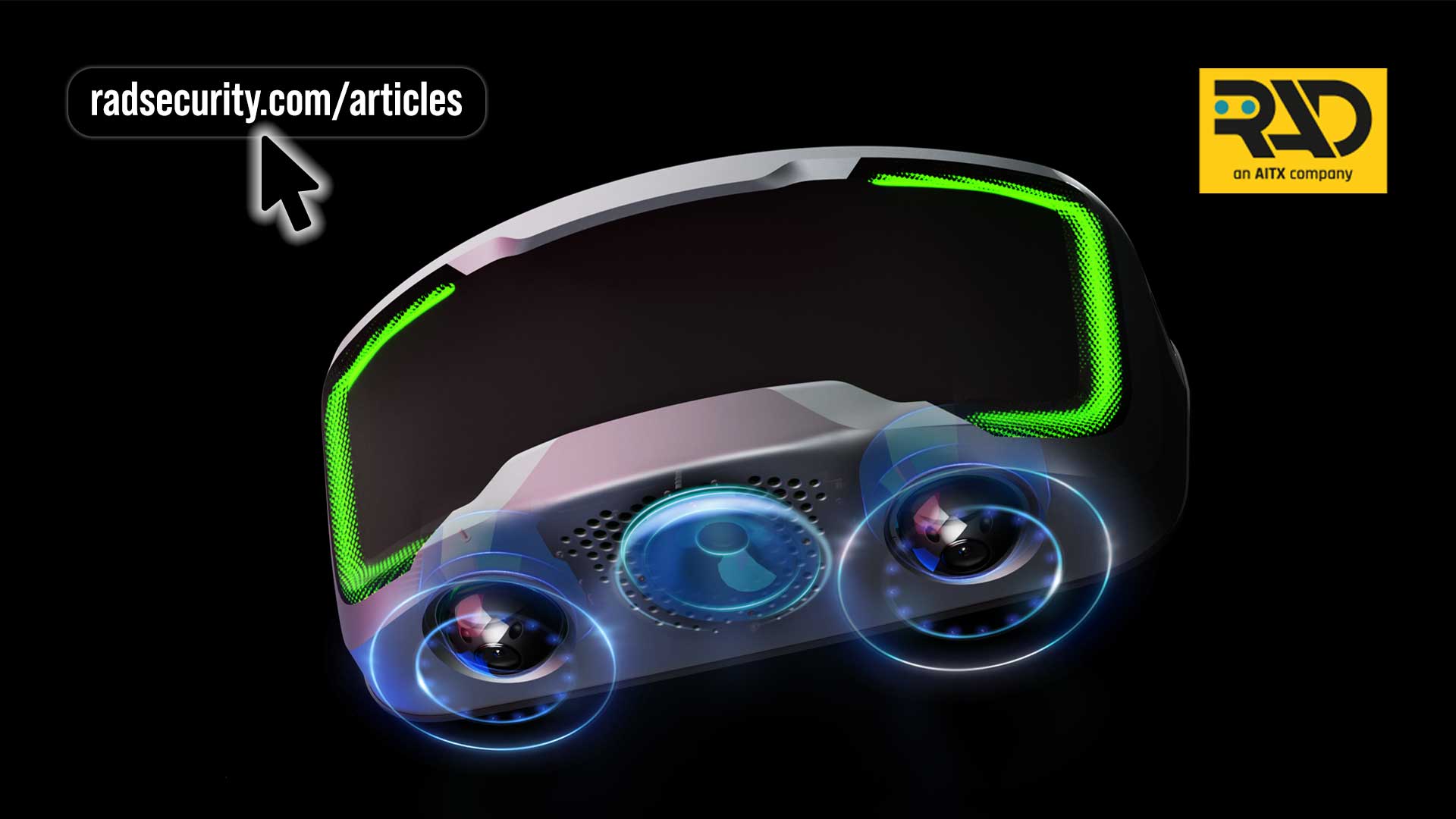
This category grew up alongside two parallel shifts. AI inference hardware became small enough and cheap enough to embed in a security camera. And the industry recognized that some decisions have to happen at the device, in milliseconds, without waiting for a network round-trip.
This guide explains what edge AI security is, what it does in the field, and how to evaluate the vendors selling it. It's written for security directors, integrators, and the practitioners who'll live with the system they choose for the next decade.
Two Industries Use the Same Term. They Don't Mean the Same Thing.
The phrase "edge AI security" gets used in two industries that mean very different things by it.
In cybersecurity, edge AI security refers to protecting the AI models running on edge devices. It covers model integrity, adversarial attack defense, firmware hardening, data privacy at the edge, and protecting IoT-deployed inference from tampering. It's a real field, and it isn't what this article covers.
In physical security, which is what this article covers, edge AI security refers to using AI at the edge of a network, on cameras and security devices themselves, to detect and deter physical threats. The "security" here is the outcome, not the thing being protected. The AI watches the parking lot. It doesn't have to be watched itself.
If you came here looking for guidance on hardening AI models against attack, you want a different article. If you're trying to figure out how AI-equipped cameras and devices are changing how facilities, perimeters, and assets get protected, keep reading.
The Computer Inside the Camera
Every modern edge AI security device contains a small, purpose-built computer designed to run AI inference locally. In the physical security industry, that computer is almost always an NVIDIA Jetson module.
NVIDIA Jetson is a family of system-on-module computers built specifically for AI workloads at the edge. The lineup includes the Jetson Nano, Jetson Orin Nano, Jetson Orin NX, and Jetson Orin AGX. Each module pairs ARM CPU cores with NVIDIA GPU cores and tensor processing hardware, which gives the device enough compute to run deep learning models on live video streams without offloading the work to a remote server.
The Jetson is doing the work.
When inference happens on the device, several things become possible that aren't possible with cloud-based analytics. Detection latency drops from seconds to milliseconds. There's no round-trip between camera and server. The device sees the event, classifies it, and executes.
Bandwidth requirements collapse. Instead of streaming continuous high-resolution video to a remote server, the device only sends out the events that matter: a detection, a snapshot, a metadata payload. A site that would have needed 50 Mbps of upstream bandwidth for cloud analytics can now run on a cellular link.
Operation continues when connectivity fails. If the internet drops, the device keeps detecting and deterring. Cloud-only systems go blind under the same conditions.
On-device response becomes practical. The same processor that runs the detection model triggers the audio talk-down, flashes the strobe, or opens a relay to a gate, all in the same compute event. No human in the loop, no cloud round-trip, no delay.
RAD Security (Robotic Assistance Devices) builds its autonomous device line around this principle. ROSA, RAD Security's edge AI security device, RIO, the solar-powered mobile security trailer, ROAMEO, the autonomous patrol vehicle, and AVA, the edge AI gate access system all ship with NVIDIA Jetson onboard. The same Jetson hardware runs across these devices, which means the same AI detection models execute consistently whether the device is a wall-mounted perimeter unit, a solar-powered trailer, an autonomous patrol vehicle, or a gate access system.
When someone asks what an "edge AI computer" is, the answer in this industry is a Jetson module running purpose-trained physical security models. The rest is implementation detail.
What Edge AI Security Does in the Field
The list of capabilities running on edge AI devices today is longer than most buyers expect. None of it is hypothetical. It's running in production at thousands of sites.
Human detection in restricted zones is the foundational capability and the one traditional video analytics has struggled with for years. Distinguishing a human from a deer, a windblown tree branch, a passing car, or a swarm of insects sounds simple. It isn't. The chronic failure mode of older video analytics is the false positive, which is why operators end up muting alerts and missing the real ones. The three-layer AI analytics engine running on RAD Security devices was built specifically to reduce false positives through a recognition, analysis, and validation pipeline.
Loitering detection flags people lingering in restricted zones past a threshold duration. The threshold is configurable. An employee on a smoke break is fine. A stranger waiting near an ATM for twenty minutes at midnight is not. The device makes the distinction without bothering a human until it has to.
Vehicle detection and classification runs continuously. The system distinguishes cars, trucks, and motorcycles, then applies different rules to each. A pickup idling in a fire lane for ten minutes is a different signal than a delivery van pulling up to a loading dock during business hours. Edge AI makes that distinction without escalating either one to a human until the situation warrants it.
Tailgating detection catches the most common physical access exploit. A second vehicle following the first through a gate without its own authorized credential gets identified at the gate, in real time, and the system executes a response: an alert to the operator, an escalation to on-site security, and a be-on-the-lookout flag on the trailing vehicle's license plate. AVA handles this natively as part of its edge AI gate access function.
License plate recognition runs at the access point. The camera reads plates, compares against allow lists and deny lists, and decides whether to open the gate. The whole transaction takes under a second. The LPR runs on the device, which means the gate operates even when the cloud connection drops.
PPE compliance runs as a continuous check rather than a clock-in formality. Cameras detect whether workers are wearing required hardhats, vests, and protective equipment. The continuous check catches the worker who put the hardhat on for the badge scan and took it off ten minutes later. The use case is mostly industrial: construction, energy, manufacturing.
Brandished weapon detection runs at the device, in real time. The system identifies firearms once they're visible in the frame, distinguishes them from other carried objects, and triggers immediate deterrence and escalation. The use case is most acute in schools, healthcare facilities, and retail, but the underlying capability applies anywhere knowing the moment a weapon appears on premises matters.
Voice talk-down and visual deterrence happen at the device. On detection, the device speaks to the subject through onboard audio, plays a recorded warning, and routes to an agentic AI operator for contextual voice down through the speaker. Most attempted intrusions end at this step. The intruder hears a voice from a camera they thought wasn't paying attention, realizes they're being seen and addressed, and leaves.
Real-time threat classification routes the events that matter to an agentic AI operator or security operator, and silences the ones that don't. A delivery truck running ten minutes late isn't a threat. A vehicle parked at the back of the building with its lights off at 2 a.m. probably is. The classification happens at the edge, in real time, and the system either deters at the device or escalates to the right next step.
These aren't lab demos. They're running today, at enterprise campuses, school districts, healthcare facilities, retail, oil and gas operations, government sites, and logistics yards.
Detection Is the Easy Part
Detection has never been the hard part. Most organizations already have cameras, sensors, and analytics that surface events. The operational failure is what happens next. Verification, deterrence, escalation, and resolution are where security programs break down at scale.
Edge AI handles speed. Agentic AI handles judgment. Modern physical security operates on both layers, and understanding the handoff between them is the difference between a complete system and an incomplete one.
Edge AI is good at fast, repeatable decisions: is this a person, is this a firearm, is this car authorized to be in this lane. The device sees, classifies, and executes a programmed response in milliseconds. That speed is what makes immediate deterrence possible. By the time a cloud-based system would have finished its first frame of analysis, an edge AI device has detected, classified, and started talking to the subject.
What edge AI can't do is reason across context. A preprogrammed response plays a voice message, flashes a strobe, and sends an alert. It can't decide whether to escalate to law enforcement, whether to call the on-call security manager, whether to dispatch a patrol vehicle, or how to adapt when the subject doesn't leave after the first warning. Those are judgment calls. They require reasoning across the broader situation: time of day, prior incidents at the site, the response policies in effect, what's happening at adjacent zones, whether there's an active event in the area.
That's where agentic AI takes over.
SARA, agentic AI platform (Speaking Autonomous Responsive Agent), sits above the edge layer. When an Edge AI device like ROSA detects an intrusion and the voice talk-down doesn't resolve it, SARA picks up the situation. SARA verifies the event, takes over voice down deterrence, and orchestrates a parallel response: notifies the monitoring center, the designated security leader, and a guarding services patrol, then files a documented incident report. Sequential execution would take minutes. SARA does it in seconds.
The architecture is hybrid by design. The edge device handles detection and immediate response. The agentic layer handles escalation and orchestration. The cloud handles logging, coordination, and compliance documentation. Each layer does what it's best at.
Edge alone is half the system. Cloud alone is half the system. The combination, with judgment supplied by agentic AI in the middle, is the best of both worlds.
Where Edge AI Lives in Real Deployments
Edge AI security deployments tend to fall into recognizable patterns. Knowing which pattern fits your situation makes vendor evaluation faster and prevents you from buying the wrong category of device.
Perimeter protection is the most common deployment. Edge AI devices mount at fence lines, building exteriors, parking lot edges, and other perimeter positions. The device detects approach in real time and executes an immediate voice deterrent before the intruder reaches the building. Most attempted intrusions end at this step because the intruder doesn't expect to be addressed by a camera they assumed wasn't paying attention. ROSA is the typical fit: wall-mounted, dual-sensor, 180-degree coverage, with voice and visual deterrence onboard.
Gate and vehicle access control replaces guard booths. The device handles LPR, tailgating detection, visitor verification, and credential validation, all running locally on the gate device. AVA is the typical fit. The economics are unusually clear in this pattern: a single staffed guard booth costs $200,000 to $400,000 per year in fully loaded labor, depending on shifts and benefits. An AVA installation typically pays for itself in under a year and operates continuously without breaks, callouts, or shift changes.
Remote and temporary sites need off-grid capability. Job sites, construction projects, oilfields, agricultural operations, anywhere with no power infrastructure, no network access, or a deployment window measured in weeks rather than years. RIO is the typical fit: trailer-mounted, solar-powered, cellular-connected, fully autonomous. The edge AI compute means detection and deterrence keep working even when the cellular link is unavailable.
Existing IP camera fleets can be brought into the same intelligence layer through the cloud. Buyers who've already spent millions on cameras don't want to rip and replace, but they also don't want their infrastructure to stay a passive recording system. The pain is real: a campus with 200 cameras represents a massive sunk cost, and replacing the fleet to gain AI capability isn't a viable budget conversation. Connecting those cameras to cloud-based analytics paired with SARA agentic AI monitoring breathes new life into existing infrastructure. The detection happens in the cloud rather than at the edge, but the orchestrated response runs through the same SARA agentic AI layer that handles the native edge fleet. The customer keeps their cameras and gains an intelligence layer.
Autonomous patrol covers ground that fixed cameras can't. Large campuses, logistics yards, university grounds, and other sites where covering ground matters more than fixed-position monitoring. A fixed camera only sees what it's pointed at. An autonomous vehicle with onboard edge AI covers routes, varies its patterns, and detects in real time wherever it is. ROAMEO is the typical fit. The vehicle runs Jetson compute, navigates autonomously, and engages or escalates events without waiting for a control center.
Most real sites end up hybrid. A logistics yard might run ROSA at perimeter positions, AVA at the entry gates, RIO at a remote staging area, and bring existing dock cameras into the same ecosystem through cloud analytics and SARA. The architectural coherence comes from the shared Jetson hardware running across the edge devices and the common SARA agentic AI layer orchestrating response across the whole fleet, including legacy cameras. The buyer gets a system that operates as a single coordinated whole rather than a collection of point solutions.
The right deployment pattern depends on the site, the existing infrastructure, the budget, and the risk profile. Most buyers underestimate how much existing camera investment they can preserve through retrofit, and how much new deployment they can do off-grid. Both observations point to edge AI security being more accessible than most security directors initially assume.
Five Questions Every Edge AI Security Vendor Should Answer
If you're shopping for an edge AI security system, five questions matter. A vendor that can answer them clearly is in the conversation. A vendor that dodges any of them probably isn't.
What happens when network connectivity drops?
Some edge AI devices can continue operating autonomously when connectivity drops. Others keep core detection and deterrence local while routing functions like agentic AI orchestration or remote diagnostics through the cloud. Both architectures can be valid depending on the deployment. What matters is that the vendor can clearly explain which functions continue and which pause when the network goes down. If they can't, they haven't been tested under serious remote conditions.
How does the system handle false positives?
Traditional video analytics famously cry wolf. The chronic failure mode is operators muting alerts and missing the real ones. A serious edge AI system has a multi-stage validation pipeline that separates detection, classification, and confirmation, and it can show measurable false positive reduction in real deployments. Ask for specific numbers from real sites, not lab results.
What happens after detection?
A device that only sends an alert to a monitoring queue is selling you half a system. The right question is whether the device itself can deter, engage, escalate, and document, or whether it just adds another notification to a SOC that's already drowning in alerts. The complete pattern is detect, deter on-device, escalate when judgment is needed, and document automatically.
Can it operate off-grid?
For deployments at job sites, remote facilities, agricultural operations, oilfields, or any site that can't guarantee building power and ethernet, off-grid capability isn't optional. Solar power, cellular connectivity, and edge inference together are what makes those deployments possible. If the device requires hard-wired power and a stable network connection, half your potential deployment locations are off the table.
Where does handoff happen?
Edge AI is half the architecture. When a situation requires judgment, escalation, or coordination, where does that happen? A vendor with no answer for this is selling a detection device, not a security system. The right architecture has a clear agentic layer above the edge devices, capable of orchestrating multi-channel response, evaluating context, and producing audit-ready documentation. SARA fills this role across the RAD Security fleet.
A vendor who can walk through all five questions clearly, with named hardware, real numbers, and honest acknowledgment of where the system has limits, is doing the work. Everyone else is selling the label.
The Math Most Buyers Haven't Run
The conversation about edge AI security usually starts with the technology and ends with the budget. The numbers are worth running explicitly, because the gap between edge AI and the alternatives is wider than most security directors realize.
A single staffed guard post, covered 24/7 by three shifts plus relief, can cost between $200,000 and $400,000 per year in fully loaded labor. The range depends on geography, union contracts, benefits, training, and turnover costs. A site that needs multiple guarded posts can quickly move into high six figures, and in many cases approach or exceed a million dollars annually. None of that captures the variability problem: guards take breaks, call out sick, get distracted, and don’t see what’s happening at the far end of a 200-acre site.
A typical third-party remote video monitoring contract for a medium-sized commercial site can run $30,000 to $80,000 per year. The contract usually buys monitoring during specific hours, with response SLAs that vary widely by provider, site complexity, and alert volume. The structural problem with this category is the operator queue: when ten sites alert in the same minute, the operator handles them sequentially, and the ninth and tenth sites wait.
Edge AI security typically deploys as a monthly subscription, making the comparison easier for buyers already budgeting for guards, monitoring, or site security services. A site that previously relied on multiple guarded posts may be able to shift portions of that coverage to four to six edge AI devices plus an agentic AI orchestration layer, depending on layout, risk profile, and response requirements. The coverage is continuous, the response is immediate, and the documentation is automatic.
The economics already favor the new architecture.
The buying conversation for edge AI security usually doesn’t end on price. It ends on whether the buyer trusts the technology to do what guards and remote monitoring used to do. The trust catches up to the math eventually. The math has been ready for a while.
From Detection to Resolution
Edge AI security is the application of artificial intelligence at the device, in real time, to detect and deter physical threats. It's not a future-state vision. It's deployed today, running on NVIDIA Jetson compute, doing work that used to require either continuous human attention or a cloud-based architecture that couldn't reach the device in time.
The architecture works because it pairs three things the previous generation of security technology kept separate: speed at the device, judgment in the agentic layer, and coordination in the cloud. Each layer does what it's best at. The edge detects and executes in milliseconds. The agentic layer reasons about what to do when the situation gets complicated. The cloud documents, coordinates, and provides oversight.
For buyers, the practical implications are concrete. Existing camera fleets can be retrofitted rather than replaced. Off-grid sites can be covered without infrastructure buildout. Guard posts and third-party monitoring contracts can be retired or repurposed. False positives can be measured and reduced, not just tolerated.
Detection is the easy part. Resolution is the work.
Frequently Asked Questions
What is edge AI security?
Edge AI security is the application of artificial intelligence models running directly on a camera or security device, rather than in the cloud, to detect, classify, and respond to physical threats in real time.
Is edge AI security different from cloud-based video analytics?
Yes. Cloud-based analytics stream video to a remote server for processing, which introduces latency and depends on continuous network connectivity. Edge AI security processes video on the device itself, which enables millisecond detection and on-device response even when the network is unavailable.
What hardware powers edge AI security?
Most modern physical security edge AI devices, including many of the RAD Security products, run on NVIDIA Jetson modules. The Jetson is a system-on-module computer designed specifically for AI inference at the edge.
How does edge AI relate to agentic AI?
Edge AI handles real-time detection and immediate response at the device. Agentic AI handles judgment, escalation, and orchestration when a situation requires reasoning across context. Modern physical security uses both, with edge AI on the device and agentic AI in the platform layer.
Is "edge AI security" the same in cybersecurity and physical security?
No. In cybersecurity, edge AI security refers to securing AI models running on edge devices. In physical security, which is what this article covers, it refers to using AI at the edge to detect and deter physical threats. The two industries use the same term to mean different things.
Can edge AI security operate off-grid?
Yes. Solar-powered platforms like RIO combine off-grid power with edge AI inference and cellular connectivity, which enables full operation at remote sites without building power or fixed networks.