

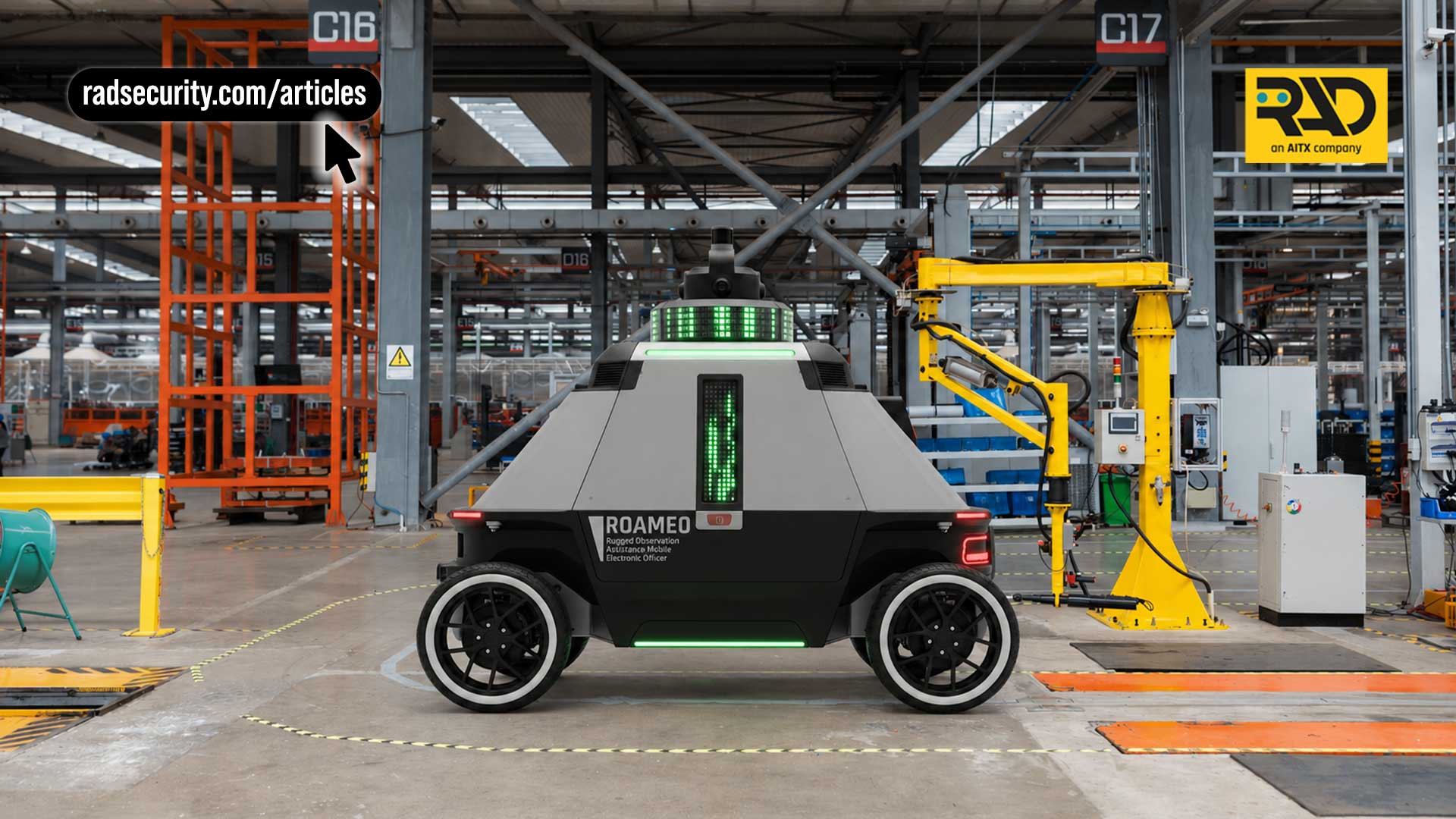
New Tools for Manufacturing Sites
Due to the sheer size of most manufacturing facilities, protecting them with limited staff and security tools has always been a challenge.
For decades, that meant deploying security patrols across the property through scheduled routes and checkpoints. But those patrols depended on officer availability, which often competed with calls, alarms, and employee requests. As a result, routes could be delayed or left uncovered.
Physical AI changes the equation by automating routine patrols throughout the property, keeping trained personnel available for active situations that require judgment, authority, or physical intervention.
“On a large property, the challenge has always been maintaining a consistent security presence across the entire site. No fixed position can cover that, and that’s why we built ROAMEO.”
Steve Reinharz, Founder and CEO, Robotic Assistance Devices
Routine Patrol No Longer Requires a Driver
A conventional vehicle patrol asks a trained security professional to spend much of their shift traveling the same routes and checking the same locations. Most passes never produce an incident, but the site still needs a visible presence and a way to identify threats.
That work is structured, repetitive, and measurable, which makes it ideal for automation. It can also consume a large share of a patrol shift, since covering distance takes time regardless of what the officer finds.
ROAMEO runs assigned outdoor routes autonomously, with a patrol range of up to 80 miles per charge and up to 16 hours of continuous operation. It follows mapped lanes, reroutes around obstacles, and returns to charge automatically when its battery is low. ROAMEO is designed for outdoor operation in temperatures from -4° to 113°F.
What the Patrol Detects on Route
A manned patrol observes only what the officer sees while traveling the route. ROAMEO uses 360° AI detection along every assigned route. It detects activity in real time, including in low-light conditions, and identifies perimeter breaches, loitering, firearms, vehicles, and license plates.
Loitering can be one of the first observable behaviors. Someone assessing a fence line, trailer row, or laydown yard may remain in the area before attempting to enter or remove property.
A fixed camera can evaluate that behavior within its field of view, while an autonomous patrol extends AI analytics along the route. This brings scheduled observation to areas between fixed camera positions.
Fixed and Mobile Systems Perform Different Jobs
ROAMEO isn’t intended to be everywhere at once. Like any mobile patrol resource, it travels an assigned route and observes the areas it reaches. Locations requiring continuous observation still need fixed coverage.
That distinction shapes the design of an autonomous security program for a manufacturing facility. Existing cameras and AI analytics can maintain continuous coverage at gates, fence lines, vehicle entrances, loading docks, and high-value storage areas.
RAD’s ecosystem includes wall-mounted devices such as ROSA, a 180° Edge AI device with built-in audio and visual deterrence. RIO provides 360° Edge AI detection and autonomous deterrence from a rapidly deployable security trailer. ROAMEO brings Physical AI patrol and a visible mobile presence to the areas between those fixed positions.
SARA Agentic AI ships with every RAD device and connects these fixed and mobile resources to the site’s incident response plan. That connection allows every device to operate as part of one coordinated security program.
When Detection Happens Half a Mile Away
At a large manufacturing facility, an event may occur half a mile from the nearest occupied post. By the time an operator reviews the alert and dispatches someone, the situation may have changed.
Consider a person lingering along a remote fence line. Whether detected by ROAMEO on patrol or a fixed camera covering that area, SARA Agentic AI verifies the event against the site’s criteria and determines whether it warrants action. SARA can issue a voice down describing the person’s location and appearance, then contact stakeholders in parallel with the context they need to respond.
The detection, verification, response actions, contacts, and outcome are documented as the incident unfolds. Instead of reconstructing the event the following morning, the security team has a record built in real time.
How Physical AI Changes Guard Spend
Physical AI changes guard spend only when it takes over recurring patrol work. If it’s added without adjusting the existing schedule, it becomes another expense rather than a different labor model.
To evaluate the impact, separate routine vehicle patrol hours from duties that require an officer’s judgment, authority, or physical intervention. Then compare the cost of autonomous patrol with the fully burdened cost of guard patrol, including overtime, recruiting, training, supervision, turnover, vehicles, fuel, and maintenance, along with the operational consequences of uncovered shifts.
For contract security providers, this creates a practical answer to a difficult renewal question: How can they expand coverage without adding more patrol hours? Autonomous patrol can cover routine routes while officers remain available for the posts and incidents where their presence matters most.
How Many Autonomous Patrol Units Does a Site Need?
Security leaders need to consider the length of each route, how frequently it must be completed, the operating hours requiring coverage, and whether multiple zones need a visible presence at the same time.
Terrain, active truck lanes, restricted areas, charging windows, service intervals, and reserve capacity for activity outside the normal route also affect the deployment. Most of these factors are specific to the site rather than the equipment.
A facility with a defined overnight coverage period may be served by a single unit, provided the required mileage and patrol frequency fit within its operating window. A plant running 24/7 may need two or more units in rotation to maintain coverage during charging and service windows.
Bottom Line
Scoping an autonomous patrol program starts with five numbers: route mileage, patrol frequency, operating hours, labor currently assigned, and the response expected when an incident occurs. Most facilities can assemble those figures from existing post orders and shift schedules.
What those numbers produce is a unit count, a route plan, and a direct comparison against the patrol hours the site is paying for today. That comparison is specific enough to a property that it has to be built from the site’s own figures.