

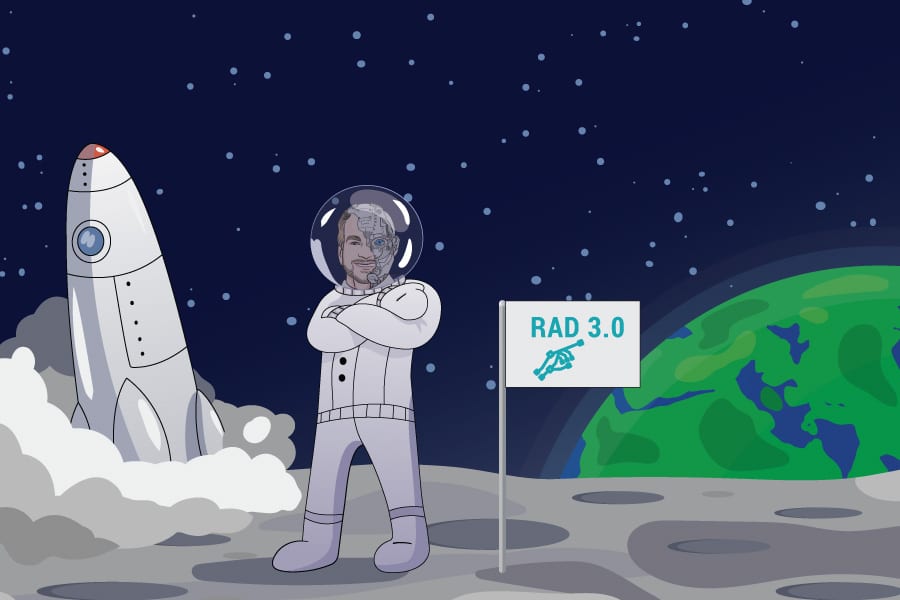
What a great time to be a tech fan! Even rockets are back in vogue these days! Every week there’s new rocket news. NASA’s Perseverance Rover hitches a ride to Mars on ULA’s Atlas V. Jeff Bezos announces plans to be part of the first crew aboard his company’s New Shepard rocket ship. Elon Musk’s SpaceX launches astronauts to the Space Station atop the Falcon 9. And that’s just scratching the surface. Wow.
Guess who else is going to the moon? AITX is!
Not literally, but RAD’s (Robotic Assistance Devices’, a wholly-owned subsidiary of AITX) growth trajectory makes for a great space analogy. Our launch vehicle of choice: the legendary Saturn V.
In addition to its starring role in historic lunar missions and standing title as the largest, heaviest, and most powerful rocket ever in operation, the Saturn V is famous for its three-stage design. How are RAD and the Saturn V alike? While we at RAD intend on becoming one of history’s most awe-inspiring companies in the security industry, today we’ll stick to our shared affinity for deploying in three stages.
Saturn V designers recognized that the engineering challenges involved in getting from earth to the moon were so vastly different at various phases of flight that a three-stage rocket would best serve their needs. The first stage did most of the heavy lifting, getting the rocket off the ground. The second stage took over at about 42 miles up and brought the rocket nearly to orbit. Finally, stage 3 required the precision and velocity to deliver the astronauts and lunar module to their destination – the moon.
In navigating the astounding growth of our company, RAD too has relied on stages. Here’s what ours look like:
RAD 1.0: Saturn V’s first stage was packed with fuel. Our stage 1, which tracks from 2016 to 2019, was loaded up with the foundational resources necessary to support lift-off.
These included the development of the Autonomous Remote Services concept, early funding, and the use of a foreign-made robot as RAD’s first mobile platform. To support those challenges RAD assembled its core staff, built a sales channel, and – of course – earned our first sales. However, as with many early launches, continued disappointments often lead to failure, or at least a change in direction. After the initial robotic platform was jettisoned, RAD decided its future was not in remarketing someone else’s product and decided to do it all internally, R&D, design, manufacturing, support, service the entire product family was to be all-RAD. The finalization of the Autonomous Remote Services (ARS) concepts lead to the launch of RAD’s first 100% homegrown solution called SCOT (Security Control Observation Tower).
RAD 1.0 also served as the proving ground for RAD’s governing philosophy, centered on the principles of emotional intelligence. Its successful implementation has been key to attracting, retaining, and empowering an A-list team of talent that has nurtured us onto the following stages. Like another heroic rocket crew, you could say that RAD’s team is made of “The Right Stuff!”
RAD 2.0: Like the Saturn V’s, RAD’s stage 2 was pivotal in positioning us for future growth. From 2019 until 2021, we’d been focused on increasing the pace of all things RAD, plus testing the viability of propelling the company even further.
We’ve invested extensively in R&D, stationary and mobile robot development, broadening our talent resources, adding dealers, and tightening our brand and message.
Expanding the product line beyond SCOT, new additions included Wally, designed as a wall-mounted alternative to SCOT, best-selling ROSA (Responsive Observation Security Agent) and AVA (Autonomous Verified Access). Throughout this phase, the company’s most innovative and complex security robot make its first appearance – ROAMEO (Rugged Observation Assistance Mobile Electronic Officer).
This is quite a load to carry for a young company grinding away in every department, but RAD is on a mission, and knows what its goals are, and knows that they will be achieved.
At this point, we’re flying high. We’re growing a loyal customer base and establishing ourselves as leaders in one of the fastest-growing security technology sectors. You might say we’re approaching orbit. And just before orbit is reached, two additional products, each originating through attending to the customer’s needs, are introduced. RAD welcomes ROSA180 and ROSA270 as well as the finalization of ROAMEO.
For many companies, that would be enough; a successful stage 2 would complete the journey. In fact, when Saturn V launched Sky Lab into orbit in 1973, the rocket only utilized two stages. It wasn’t going to the moon. However, as we’ve already stated, we’ve set our sights higher – by a mere 238,900 additional miles. Stage 3 will get us there!
RAD 3.0: The prestige of being the first to bring humans to the moon’s surface elevated U.S. space program to a new level. In the ultimate competition of ingenuity, brain-power, and pure audacity, NASA, with the help of many indispensable partners, won the gold medal. Now, as RAD embarks on our own stage 3 (RAD 3.0), we’re prepared to do the same.
This final stage involves many complex maneuvers, like continuously adding to our long list of solution functions, implementing incredible design improvements, moving into a new production facility, expanding our corporate staff and sales force, and rolling out aggressive advertising and marketing. It also includes carving out market share as we rapidly deploy devices. Ultimately, “reaching the moon” means redefining the security services industry, making Autonomous Remote Services (ARS) the default method for supporting proactive security and public safety operations. We’re planting our flag there and inviting all to join us.
To Infinity and Beyond
For now, we’re heading to the moon, but don’t expect us to stop there.
The Saturn V served its purpose well, but today’s reusable rocket designs are again pushing the limits of what was once thought impossible. The fourth industrial revolution is having the same impact on electronics. Many of our devices perform functions today that were pure science fiction little more than a decade ago. By that measure and in today’s context, RAD’s ARS model is more akin to paradigm-breaking rockets like the Falcon 9, Heavy, and Starship than the tried-and-true Saturn V. And like them, the moon is only our next stop.
Our real destination: conquering the universe!