

by Steve Reinharz, RAD Founder and CEO
June, 2024
Since Columbine, the number of U.S. students who have personally experienced gun violence while at school exceeds 311,000. Six months into 2022, there have already been at least 24 shooting incidents on K-12 campuses [1]. I’m sure the number is higher by the time you are reading this.
All Americans agree that the situation is tragic. What we can’t agree on is what to do about it. I don’t have to tell you that gun policies are one of the most politically charged issues in our culture. Some argue that the solution is to put armed guards in schools and allow teachers to carry concealed weapons in classrooms. They believe that more guns in the hands of “good people” will stop their misuse by “bad people.”
On the flip side are citizens equally passionate about reducing the availability of guns. They seek to limit or ban the sale of semi-automatic weapons, raise the age to purchase firearms, and institute waiting periods and universal background checks.
Our country seems to be in a perpetual stalemate. We don’t have to be. More can be accomplished at the local level in ways that entire communities can agree upon. These include investment in technology that may prevent an attack, and certainly mitigate the harm if one occurs.
With that goal in mind, active shooter drills at school have become as routine to today’s kids as duck and cover drills were for their grandparents. Let’s augment those efforts with the latest AI-assisted camera and software solutions that can alert security personnel of a person wielding a gun before the shooting starts. New intelligent surveillance systems can autonomously detect a person carrying a firearm – either handgun or rifle – from as far away as 250 feet. Best case scenario: The attack is averted. Worst case scenario: Teachers and students have more time to prepare, law enforcement and EMS are notified more quickly, and help arrives sooner to end the incident and attend to victims.
It’s time for the parents, school boards, and local legislators to demand funding for such systems. Their benefits are clear. Medical professionals specializing in treating trauma will tell you that patients have, at most, 1 hour after an incident to receive definitive care before morbidity and mortality increase significantly 2. In an active shooter scenario, getting help to the scene asap is a matter of life and death.
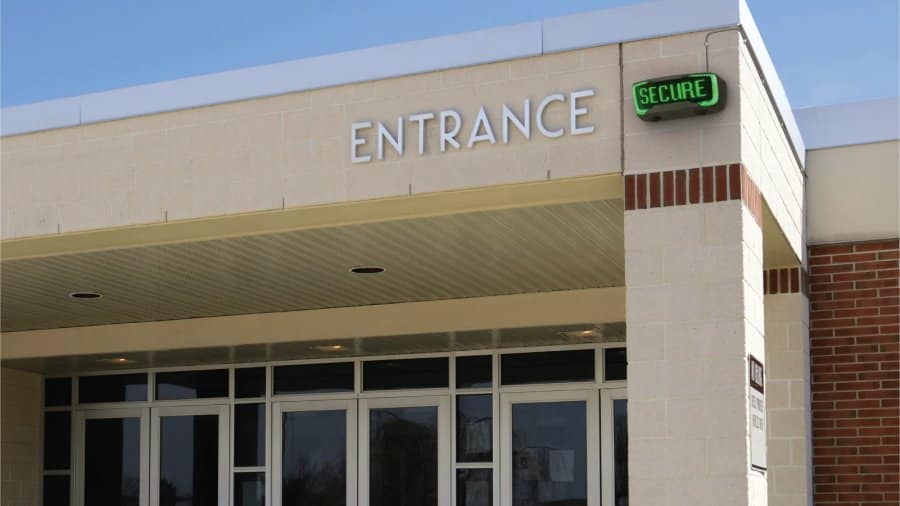
In the year immediately following Sandy Hook, many states allocated generous grants to schools wishing to update their security infrastructure. Connecticut, where the Newtown massacre occurred, made $21 million available [2]. The New York State Smart Schools Bond Act of 2014 allocated $2 billion in funding for enhancing school technology and infrastructure [3] – much of which was used by schools for security upgrades. As a result, most K-12 schools today have cameras watching over their grounds, entrances, and strategic indoor locations. They also have electronic access control and visitor management systems that restrict who may enter the building and where they can go, and emergency notification systems to keep students, teachers, and parents in the loop. Those systems were considered state-of-the art a decade ago, when installed, but advances in artificial intelligence now offer the potential to move things to the next level.
The truth is that the majority of school cameras are rarely monitored live – or at least not diligently. In a typical school, a single security guard sits at a reception desk equipped with a computer monitor. At any one time, video from a few cameras display on a rotating basis, but the officer lacks broad situational awareness of what’s happening campus-wide. Plus, the officer is focused on other matters, like signing visitors in and out and checking IDs. For the most part, school security or administrators rely mostly on recorded video, searching after the fact to see who was at fault for a fender-bender in the parking lot or to identify last weekend’s graffiti artists. In today’s active-shooter era, this isn’t acceptable. If there are to be cameras in place, they need to be monitored in real time.
To do this, schools should be leveraging artificial intelligence as a force multiplier. Districts don’t have the budgets to hire enough guards to watch all those cameras, but AI can do it for a fraction of the price and do a better job. The technology’s game-changing value has already been proven. In response to September 11, 2001 camera algorithms that detect “objects left behind” revolutionized how public safety teams monitor high-value, high-traffic terrorism targets, like subway platforms, airports, commercial business districts, and stadiums, looking for hidden explosives. Today, security operation centers consider the use of smart cameras as non-negotiable. There’s no other way they could effectively notice an unattended backpack or rice cooker in the video feed they receive from thousands of cameras. Don’t our school security teams warrant the same technological assistance in detecting an equally menacing threat?
AI-driven solutions are no longer expensive, difficult to install, or prone to false alerts. They are available as turn-key systems, integrated within video security platforms, or as add-on software that existing IP cameras can use. Once a firearm is detected, an alert is issued to authorities, and a series of automated responses are triggered that leverage the full capabilities of the site’s security technology infrastructure. For example, in an ideal situation, a firearm identified outside the building would trigger an immediate lockdown to prevent the gunman from entering. If the gun remained concealed until he was inside the building, a well-programmed access control system would impose lockdown conditions that isolate the gunman while allowing those with access to a doorway to escape. Integrated communication tools could inform teachers and administrators of what’s happening beyond their classroom, providing shelter-in-place or evacuation instructions. Live video shared with law enforcement could give insight into the situation, aiding in response coordination. The bottom line: help arrives sooner, is better prepared, and is more likely to save lives.
Advances in AI have made camera analytics a part of our daily lives. They read our license plates to collect tolls, track our shopping patterns to help retailers design displays, count people to prevent overcrowding, and recognize faces to speed up entry checkpoints.
Why, for heaven’s sake, aren’t we using similar, readily available solutions to identify firearms on school and other facility campuses? Our kids deserve better. We all deserve better.
[1] http://washingtonpost.com/graphics/2018/local/school-shootings-database/
[2] https://www.reuters.com/article/usa-connecticut-schools/connecticut-adds-16-mln-to-boost-school-security-after-newtown-idINDEE9AB0DE20131112
[3] http://www.nysed.gov/edtech/smart-schools-bond-act#:~:text=The%20Smart%20Schools%20Bond%20Act,for%20students%20throughout%20the%20State.
Steven Reinharz is CEO of Artificial Intelligence Technology Solutions, Inc. (AITX) and founder of the three RAD subsidiaries Robotic Assistance Devices, Inc. (RAD), Robotic Assistance Mobile (RAD-M), and Robotic Assistance Devices Group (RAD-G). Born and raised in Canada but working in the US since 1995, he is an active voice in the security and robotics industries. His experience is multi-faceted in that he started and ran his own security integration company early in his career, then becoming one of California’s premier integrators,
Steve is a champion for change, developing AI-powered solutions that perform the duties of traditional manned staff and gain higher levels of situational awareness, at dramatically lower costs. His recent safety solutions, such as RAD Light My Way and Firearm Detection are examples of Reinharz’ efforts to turn the once futuristic promises of AI and automation into today’s realities. Reinharz regularly speaks and contributes to panels at ISC East and West, other SIA events, GSX, plus ASIS. Reinharz was recently named as a Board Member of SIA and Chair of SIA’s ‘AI, Drones and Robotics Interest Group’.