

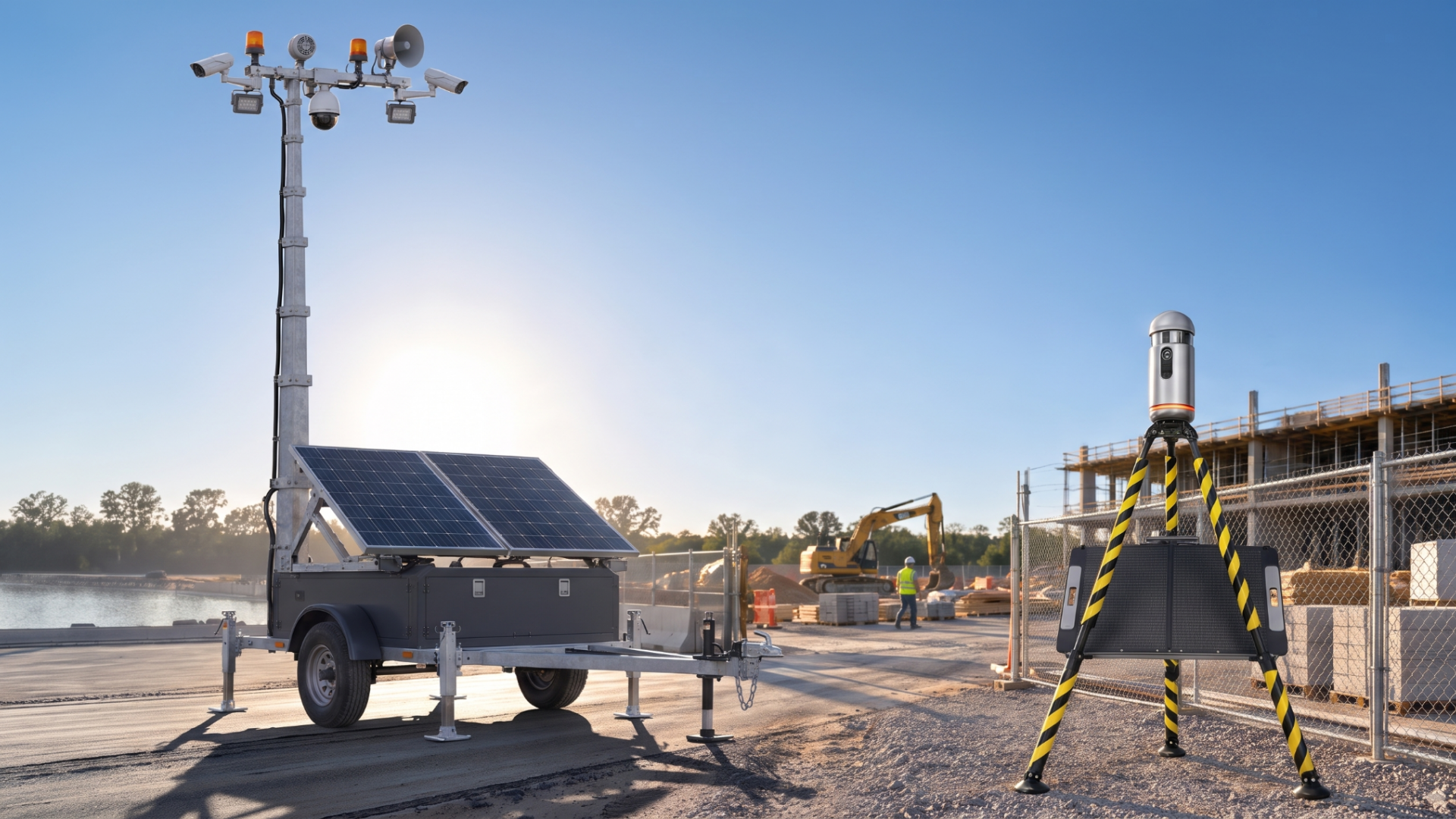
That’s how it sounds when a portable solar security tower shows up in two boxes and the first question is, “Where’s the trailer?”
The trailer earned its place. It gave the industry a way to get cameras, batteries, solar panels and a mast onto sites that needed security before they had permanent power. Tow it in, set it up, put it to work. For plenty of jobs, that was a smart answer.
Somewhere along the way, the industry got so comfortable with that answer that the trailer became part of the question. Need temporary security? Start by finding something with a hitch.
It’s worth asking how much of that rig the job actually needs.
Make the Trailer Earn Its Place
Imagine you’re the superintendent on a construction project. The copper arrives Thursday. It’ll be staged near the east gate, where there’s been trouble after hours. In two weeks, the crew moves the gate and the copper goes with it.
You need to know when someone enters that area after hours. You need a way to intervene while they’re still there. And when the work moves, you need to move your coverage with it.
Now look at what it takes to deliver that outcome. Who gets the tower to the site? How much room does it take up? Who can move it when the gate shifts? Does that person need a truck, a hitch or a call to the rental provider?
Those questions rarely get the attention that camera specs do. They matter quite a bit on a Friday afternoon when the superintendent has a crew waiting to pour concrete where the security trailer is parked.
A towable unit can make sense. A site may need a taller mast, more battery capacity or room for additional equipment. Put those requirements in the bid. Give them a number and a reason. If the trailer is there because it’s what the supplier already has in the yard, somebody should say that out loud, too.
What Happens When You Start With the Job?
With RAIA, we started with a practical question. How much equipment does one person actually need to bring solar security to a site and put it to work?
Our answer ships in two boxes. One person can set it up in minutes. The tower combines solar power, cameras and SARA, RAD’s autonomous security AI. When RAIA detects a person or vehicle, it can respond with deterrence lights and an audible warning. The same person who set it up can reposition it as the job changes.
The two boxes got us thinking about how to show the difference. So we made a short film in which a guy goes to a big box store for paper towels, spots a pallet of security towers and gets a little too excited. By 11 p.m., his tower is responding to a trespasser at the jobsite while he’s sitting on his couch.
The store aisle is a gag. The boxes are real. And if the idea of a security tower coming home in a shopping cart strikes you as ridiculous, consider how much of that reaction comes from years of seeing the same equipment on wheels.
Ask for the Quote That Includes Moving Day
The best place to test this is on the next bid. Give suppliers an actual site plan and tell them what will change during the job. Ask them to price the first deployment, a move halfway through, and pickup when the work is done.
Then ask them to walk you through what happens at 11 p.m. when someone heads toward the equipment yard. What does the system detect? What can it do on site? Who gets notified? Have them show you the sequence.
That’s a more demanding conversation than asking for a monthly rate and comparing spec sheets. It forces every supplier, RAD included, to account for how the equipment gets there, who can work with it and what it does once the crew goes home.
For dealers and integrators, there’s another question worth asking. How many short jobs or small sites have you passed on because getting a trailer there and back ate too much of the margin? Think about the customer who needed coverage at one gate for a few weeks. With a tower you can ship in two boxes and set up with one person, would you quote that job differently?
The Hitch Is Going to Have to Explain Itself
The buggy analogy has its limits. Trailers will keep doing jobs where their size and capacity pay for themselves. The bigger question is how much business the industry has overlooked by treating the trailer as the default.
If your first instinct is to defend the trailer, go ahead. Show the customer what the chassis, wheels and towing buy them on their site. Put that case next to a portable tower and let them see how both get delivered, set up and moved. Then let them watch what each one does when somebody walks through the gate after hours.
We’re happy to put RAIA through that comparison. Give us a site plan, a gate that moves and a real problem to solve. We’ll bring the two boxes.
Explore RAIA and request a demo.