

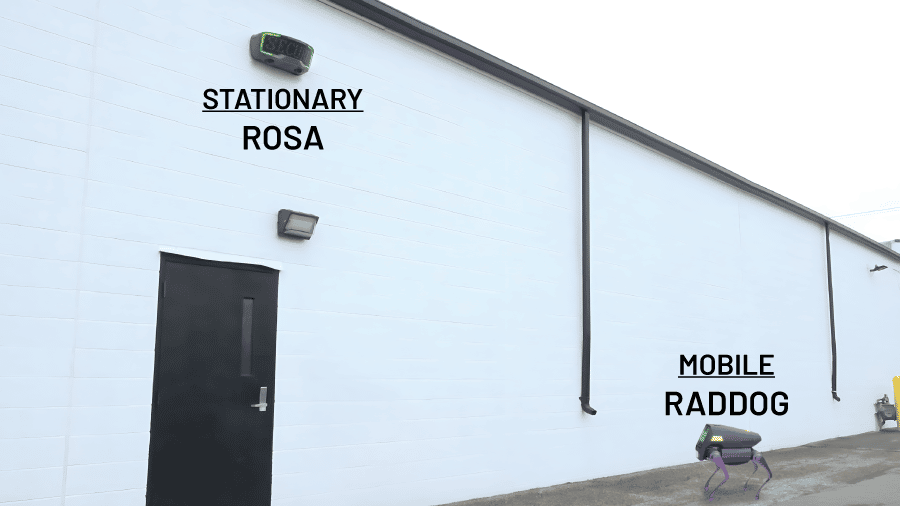
Stationary security robots, like RAD’s ROSA and AVA along with mobile security robots (ROAMEO and RADDOG) are two of the most important tools in modern security systems. While stationary security robots provide a constant and uninterrupted view of a given area, mobile security robots offer the ability to physically interact with and respond to detected security threats. The interaction between these two advanced technologies can significantly enhance the overall security of a given area and provide a more complete picture of what is happening on the ground.
Stationary security robots can be placed in a fixed location to provide continuous monitoring of a particular area. This can be incredibly useful in a variety of situations, such as monitoring a high-risk area for criminal activity or monitoring a construction site for potential perimeter breaches. These devices can detect and alert security personnel of unusual activity and coordinate an autonomous response with its mobile counterparts.
Mobile security robots, on the other hand, are designed to move around a given area, providing a more dynamic and interactive security presence. These robots are also equipped with cameras, audible and visual alarms, allowing them to respond to security threats in real-time. Mobile security robots are particularly useful in situations where a human security presence would be too dangerous, costly or impractical, such as in large properties or large-scale construction sites.
The interaction between stationary security robots and mobile security robots can greatly enhance the overall security of a given area. For example, stationary security robots can provide real-time updates to mobile security robots, alerting them to potential threats and allowing them to quickly respond to these threats. This can be particularly useful in high-risk areas where there is a constant threat of criminal activity. In these cases, stationary surveillance devices can provide the necessary information for mobile security robots to respond quickly and effectively, neutralizing the threat and preventing any harm to individuals or property.
In addition, stationary security robots and mobile security robots can also be used together to create a more complete picture of what is happening in a given area. This can be particularly useful in large properties and facilities, where there is a need to monitor multiple areas at once. Stationary devices can be used to provide a constant view of a given area, while mobile security robots can be dispatched to on-demand move around the site, providing a more dynamic and interactive security presence. By working together, these two technologies can provide a complete view of the property, alerting on-site or remote monitoring security personnel to potential threats and allowing them to respond quickly and effectively.
Finally, it is worth mentioning that the interaction between stationary surveillance devices and mobile security robots can also provide valuable data for future security operations. This data can be used to analyze and understand the nature of security threats, allowing security personnel to develop more effective strategies for preventing and responding to these threats. For example, data on the movement patterns of criminals in a given area can be used to determine the most effective places to install stationary surveillance devices, while data on the effectiveness of mobile security robots can be used to optimize their deployment and improve their overall performance.
In conclusion, the interaction between stationary surveillance devices and mobile security robots can greatly enhance the overall security of a given area. These two technologies can work together to provide a more complete picture of what is happening on the ground, allowing security personnel to respond quickly and effectively to security threats. Additionally, the data collected from this interaction can be used to analyze and understand the nature of security threats, allowing security personnel to develop more effective strategies for preventing and responding to these threats in the future.
Are you interested in learning more about how RAD’s security robots can improve the safety and security of your facility? Don’t hesitate, contact us today to schedule a consultation and see for yourself the benefits of implementing RAD’s innovative technology. Our team is ready to answer any questions you may have and provide you with the information you need to make an informed decision. Don’t miss out on this opportunity to upgrade your security system – contact us today!