
The Short Answer
A risk assessment scores a site based on its threats, its vulnerabilities, and the controls in place to reduce them. Cameras are one of the biggest controls in that score, and they're also one of the least stable. They go offline, get blocked, and slowly lose the view they were installed to capture, usually without anyone noticing.
Keeping the score accurate means checking the cameras between assessments and feeding what you find back into the risk picture. That's the job SARA Assess was built to do.
What Happens to Cameras Between Visits
Anyone who has managed a large camera estate knows the list. A switch port fails and a camera drops off the network. A contractor unplugs a PoE injector during a remodel and forgets to plug it back in. A firmware update doesn't come back cleanly.
Other failures are harder to catch because the camera stays online. Landscaping grows into the field of view over a summer. A mount loosens and the camera slowly drifts until it's looking at the side of a building. A delivery truck parks in the same spot every night and blocks the only view of a side door. The stream is live, the recorder is recording, and the camera counts as healthy while it watches a hedge.
None of this shows up in the assessment. The report still credits the site with coverage it no longer has, and the portfolio view ranks that site accordingly.
Why Doesn't the Finding Reach the Score?
Say a regional manager does notice that a parking lot camera has been dark for a month. The finding goes into an email to facilities, or a spreadsheet, or a note for the next assessment. Someone opens a ticket. A technician gets scheduled when one is available.
Meanwhile, the risk score doesn't move. It waits for the next formal review, which might be a year out. The security team keeps making budget and staffing decisions from a picture of the site that stopped being accurate weeks ago.
Finding a bad camera was never the hard part. Getting that finding into the risk score and turning it into a repair that someone tracks to closure is where the process breaks down.
How SARA Assess Works
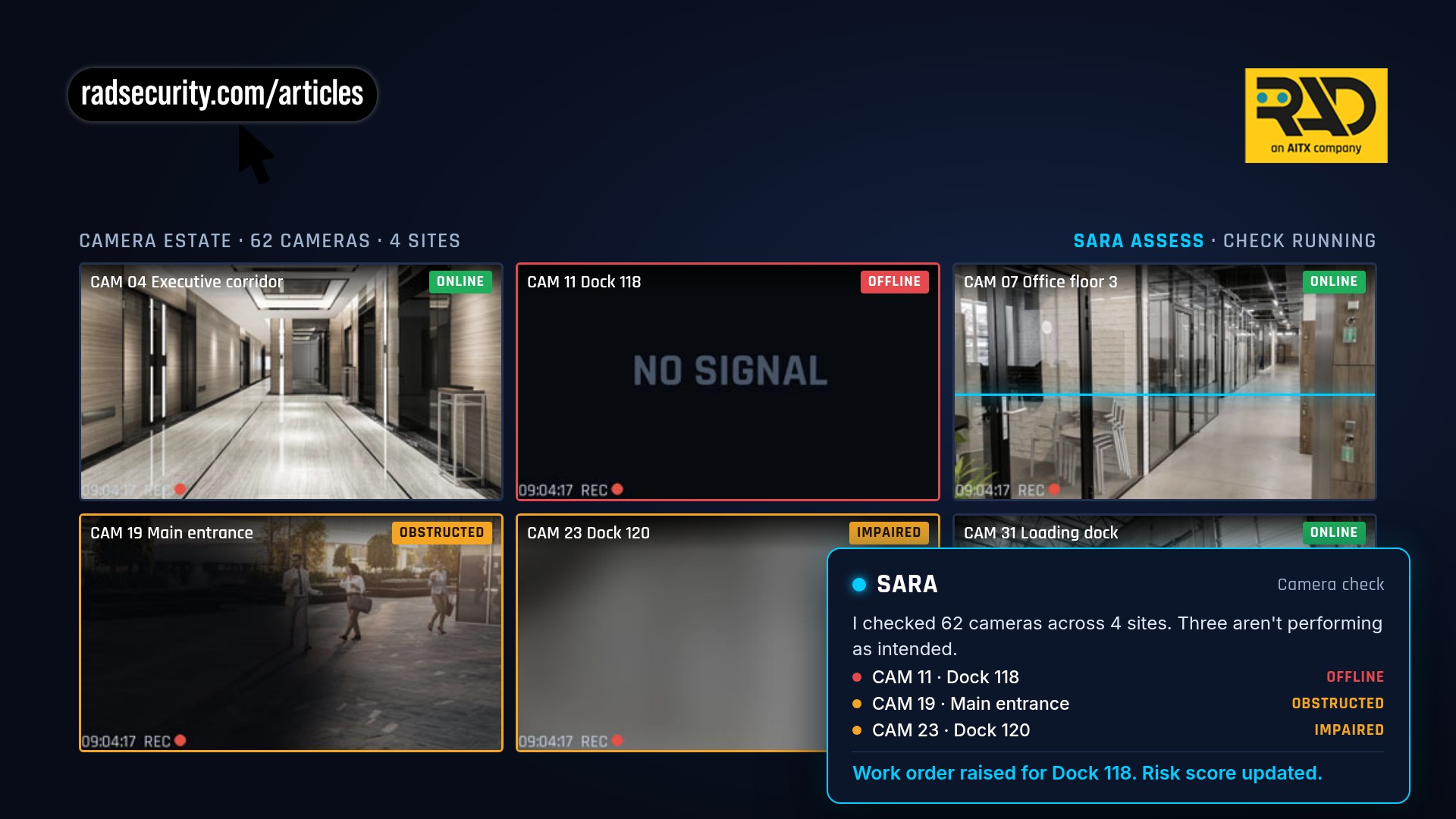
SARA Assess connects SARA Agentic AI to the cameras a site already has and keeps checking them. For organizations that run their physical risk program on Circadian Risk, it closes the loop with the platform:
- Connect. SARA connects directly to existing cameras over ONVIF Profile S and RTSP. No RAD hardware is needed to start.
- Verify. It checks connected cameras for offline, obstructed, impaired, or underperforming conditions.
- Report. Findings pass into Circadian Risk, attached to the site and asset they belong to.
- Score. The site's risk score moves to reflect what's working right now.
- Act. A task, work order, or supported corrective action is raised and tracked to closure.
Then it runs again. The formal assessment still sets the baseline for threats and site context. SARA Assess keeps the camera side of that score tied to what's in the field between visits.
The camera check is the part every multi-site team needs, whatever platform holds their risk scores. Knowing which cameras are down, blocked, or drifting, site by site, is useful on its own, and it's the fastest way to find out what the last assessment missed.
“SARA is not confined to the devices we manufacture. It can work across third-party security systems, interpret operating conditions, and return meaningful intelligence to an enterprise risk platform.”
Steve Reinharz, CEO/CTO, AITX and RAD
SARA Assess is the first commercial integration between SARA and a third-party physical risk intelligence platform. Because it runs on existing cameras, it gives teams a software-led way to verify what they already own before they spend money on anything new.
Who Uses the Findings?
The security director gets a portfolio view they can defend. When a site ranks as low exposure, the cameras behind that rating have been checked since the last visit, which makes the next budget conversation a lot easier.
Risk and compliance teams get a cleaner record. The finding, the score change, and the corrective action sit in Circadian Risk against the same site and asset, so there's an answer ready when an auditor or insurer asks what happened and when.
For dealers and integrators, a work order that names the site, the camera, and the problem is a service call with a clear scope. It also keeps the systems they installed performing the way the customer expects.
How Do You Start?
Start with the sites where a missed camera would hurt the most. That's usually the locations with the highest risk scores, a history of incidents, or the biggest camera counts.
Run continuous verification there and compare what it finds to what the last assessment recorded. The difference between the two lists is the exposure your portfolio view has been missing, and it's specific enough to act on site by site.
SARA Assess is available now for pilots and full deployments. See how SARA Assess keeps the camera side of your risk assessment current. Request a demo.