

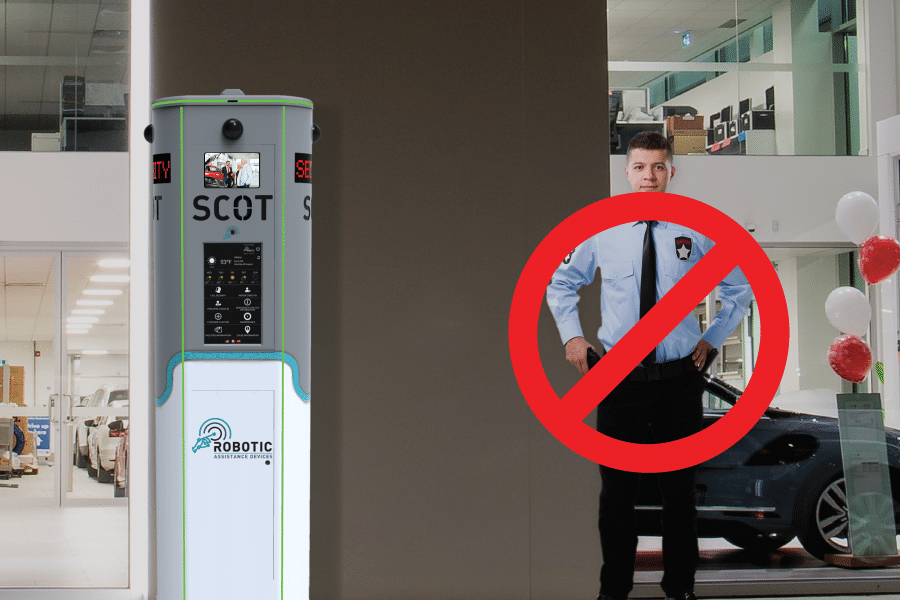
For those who create, sell, or employ Autonomous Remote Services (ARS), return-on-investment (ROI) is always a hot topic. We spend a lot of time comparing the price of security services delivered via technology to the cost of manned guard hours or HPW (hours per week). No surprise, technology provides better value.
The metrics are a powerful argument for transitioning to an ARS model, but only for companies that already include human guard services as part of their security operations budget. The “savings” are often irrelevant to companies that can’t afford guard services in the first place.
For these organizations, what’s the value proposition for investing in ARS?
Companies decide whether or not to employ security guards based upon a calculated analysis. They weigh the cost of perpetual guard services against the routine losses and site damage that would occur from the lack of such coverage. When, on balance, risk exposure tips the scale downward, the cost of guards is justified. Otherwise, the companies will pass on the expense.
Here’s where it gets interesting. While most are not surprised that leveraging ARS technology costs less than hourly guard workers, the magnitude of that difference is typically underestimated. Seriously underestimated! ARS doesn’t just cut the cost of security services by a few percentage points. ARS slashes costs by more than half! At the same time, it provides more extensive coverage, 24/7, with proven results that outperform human guards. As a result, a substantial percentage of small to medium-sized companies who opt out of traditional guard services find that when they place the cost of ARS on their metaphorical teeter-totter to weigh it against the expense of risk exposure, the risk side comes slamming down. Potential losses and damage due to lack of security far outweigh any investment in autonomous remote services.
At Robotic Assistance Devices (RAD), we’ve seen this calculation made repeatedly by our customers. ARS has enabled companies that otherwise would be doing nothing – and paying for the consequences – to proactively address many of their security-related challenges.
Citrus Construction, one of Florida’s leading licensed construction contractors, is one such example. It currently deploys ROSA, RAD’s Responsive Observation Security Agent, at its construction sites during off-hours. The company needed an effective and affordable way to deter trespassing, reduce criminal activity, and respond to suspicious incidents. It had tried deploying traditional security guards without success and had therefore been functioning without any on-site security services in recent years.
Since mounting ROSA units at the entrances to their construction areas, Citrus has seen a quantifiable drop in criminal activity. Programmed to detect vehicles and humans that come within 250 feet, the ROSA devices autonomously respond to trespassers with a visual warning to leave immediately. Audio and visual messaging intensify as necessary, including the option for monitoring personnel to issue live instructions over ROSA’s loudspeakers. The units are a true force multiplier. “ROSA is doing the same or better than having a security guard in place. When ROSA sees someone at night, its response is scary enough that it does the trick,” says Greg Van Haute, Vice President at Citrus Construction.
Midway Car Rental, the largest privately-owned car rental company in Southern California, also deploys ROSA units. Unlike Citrus, it has never hired human guards to patrol its lots. However, due to issues with vandalism, graffiti, and aggressive vagrants, the company needed a proactive security solution. Sean Perez, Midway’s General Manager, says, “Thanks to the ROSA units, we’ve addressed all sorts of issues. Damage to vehicles, graffiti on the exterior of the building, the homeless tampering with our electrical outlets to charge their phones, trash left around the property – that’s all gone since we put the ROSAs in.”
The Citrus and Midway examples upend the traditional security services model in other ways too. Human guard services are expensive not only due to the high cost of hourly, on-site officers but also for the monitoring and dispatch services provided. While RAD does offer an option to monitor its clients’ ARS devices, including ROSA units, management at Citrus and Midway have opted to handle this role themselves, at least for now. They receive automated text alerts whenever an event occurs, along with a link to an associated video clip. In most instances, ROSA’s automated response resolves the situation without any human intervention. However, when necessary, system administrators can initiate further actions, including live communication with the site and contacting law enforcement. False alerts are infrequent, thanks to the accuracy of ROSA’s cloud-based intelligence. Each company has ROSA units deployed at multiple locations and can manage and view video from all their devices using a centralized, web-based dashboard.
As Citrus and Midway add more ROSA units across their properties, they will ultimately turn to RAD to assist with remote monitoring. Again, the difference in pricing between traditional guard services and ARS is striking. Because the technology is such an effective deterrent and can autonomously resolve the vast majority of events, monitoring personnel are far more efficient, focusing their attention only where needed. Companies that would typically not invest in a monitoring service can now afford to outsource this burden.
Defining the right ROI metrics are critical to making the argument for ARS. For some companies, comparing the cost of our new security services model to the old model does just doesn’t resonate. Instead, in these instances, the cost of ARS must be evaluated in contrast to the cost of transgressions.
Plus, as Midway’s General Manager reminds us, “There are important intangibles that you really can’t put a price tag on, like an improvement in employee well-being and productivity because our staff now feels safe at work.” Thanks to the force-multiplying capabilities of ARS, these benefits are finally well within the budget of most small to medium-sized businesses.