

Logistics facilities already have cameras almost everywhere they're needed. The harder problem isn't seeing what happens. It's how fast it can be verified and acted on, across every site, at any hour.
Most sites have cameras at the gate, along the fence, over the docks, and across the lots. What they don't have is a reliable answer to the question that matters most, which is what happens in the ninety seconds after something is detected. Is the event verified, or is it sitting in a queue? Does the system know whether it matters? Can it push back on someone onsite before they reach a trailer? Can it reach the right person with context, and produce a record that holds up afterward?
That gap between seeing an event and resolving it is where loss happens, and it's the gap AI is finally built to close. The trouble is that "AI security" has become a catch-all term that hides real differences. Four distinct kinds of AI do four different jobs at a logistics site, and understanding how they differ is what separates a smarter operation from a noisier one.
Four Kinds of AI, Four Different Jobs
Before mapping any of this to a property, it's worth being precise about what each layer does, because no single one resolves an incident on its own.
AI analytics answers the question of what is happening. It applies computer vision to live video to identify people, vehicles, and objects, and to flag the events that match defined rules, whether that's a person in a restricted zone, a vehicle idling in a controlled lane, a weapon, or missing PPE. This is the detection foundation everything else builds on.
Edge AI answers a different question, which is how to act locally and instantly even when the network isn't cooperating. The analytics run on the device itself rather than in a distant cloud, so detection and deterrence happen in milliseconds and keep working if connectivity drops. At a site with long fence lines and uneven coverage, that distinction is the difference between stopping an event and reviewing it the next morning.
Physical AI answers the question of presence that moves. These are autonomous robots that patrol, navigate real terrain, and put a visible, mobile deterrent into the spaces fixed cameras can't reach, like the open yard, the far lot, and the ground between patrol rounds.
Agentic AI answers the question of who runs the response. It's an autonomous operator that verifies an event, decides what to do under defined policies, delivers the warning, escalates to the right people, and writes the report, coordinating the other three layers instead of waiting for a human to notice an alert.
Detection without an operator is just more alerts, which is why the value of AI security isn't any single device. It's these four layers working as one response model across the whole property. Here's how that plays out, zone by zone.
The Gate: Edge AI Where Throughput Meets Control
The gate is the first decision point and the first bottleneck. Every truck, vendor, driver, and service vehicle is a question. Is this vehicle expected? Is the plate recognized? Is the credential valid? Is someone tailgating an authorized entry? Handle it too slowly and the lane backs up, and handle it inconsistently and enforcement collapses the moment the gate gets busy.
Manual verification forces a trade-off between speed and control, and Edge AI is what removes it. RAD's AVA, Autonomous Verified Access, validates PIN codes, QR codes, barcodes, driver's licenses, and license plates right at the gate, processing everything on an onboard NVIDIA Jetson Orin NX module. Because the AI analytics run at the edge, the system detects activity and triggers onsite action immediately, instead of waiting for manual review, and it keeps verifying even if the network drops. Its dual 5MP PTZ cameras cover 180 degrees of the approach so it can watch vehicle spacing and catch tailgating as it happens. It needs only power, mounts on a standard gooseneck pedestal, and can be operational in under a day.
The point isn't faster entry, although that comes too. It's consistent control over who enters, how exceptions are handled, and how every gate interaction feeds the rest of the security operation, applied the same way at every site whether the lane is empty or backed up.
Perimeter and Yard: Edge AI That Acts Instead of Records
A fence is only as strong as the response behind it. Logistics perimeters run long, with uneven lighting, outdoor blind spots, and trailer rows that change sightlines from one week to the next. A person crossing the fence after hours might be perfectly visible on camera, and that visibility means nothing if the response is a motion alert someone reviews later.
This is where Edge AI earns its place. RAD's ROSA is a mobile edge AI security tower that combines detection and automated deterrence in a single unit with 180-degree coverage and 5G connectivity. It detects people, vehicles, and objects against the zones and rules defined for the site, then pushes back on the spot with long-range audio through a 110 dB speaker and visual alerts, and it escalates verified events without waiting for someone to catch the clip. That moves the perimeter from passive observation to active intervention, in the window when intervention can still change the outcome.
Yards and lots are a harder version of the same problem, since they're large, exposed, and constantly rearranged. A staging area that was low-risk last quarter turns high-risk during a volume surge, and trenching power or running network for permanent cameras every time the layout shifts simply isn't realistic. The RIO security trailer solves the infrastructure side of this. It runs completely off-grid on solar with battery storage, ships with included cellular, deploys by forklift or flatbed, and operates around the clock with zero IT setup. It carries the same edge AI analytics as the fixed units, including license plate recognition and firearm detection, along with the same deterrence and escalation path. That puts response where the risk is this month rather than where the conduit happened to be buried two years ago.
Ready to see this in your environment? Walk through your own gates, yards, and docks with our team and see how AI detection, edge deterrence, and Agentic AI response work across a live logistics footprint. Request a demo.
Loading Docks and Existing Cameras: AI Analytics on Infrastructure You Already Own
Docks are the most active part of the facility and the hardest to read. People and vehicles move constantly, doors open and close, and the same scene can be routine during a shift and a genuine concern once the crews go home. A person near a dock might be authorized or not, and an open door might be intentional or a breach. That's relentless exception handling, and it's exactly what AI analytics is built to classify.
Docks are also where most facilities already have cameras, and replacing working infrastructure is rarely the right play. The smarter move is to make those cameras think. RAD's SCANNA onboarding tool scans local networks or public IP addresses to discover third-party IP cameras and NVR channels, validates each stream, previews the live feed, and prepares it for the RAD platform, which turns what used to be a manual and error-prone integration into a guided handoff. For large multi-site environments running hundreds of existing cameras, a server-based appliance brings high volumes of IP feeds into the same AI analytics and Agentic AI workflow without a forklift upgrade.
The goal isn't to turn every camera into a source of noise. It's to decide which events matter and connect them to a process that verifies, escalates, and documents, so the cameras already paid for become part of a real response operation instead of a passive recording layer.
Interior Zones: AI Analytics Beyond the Fence Line
Security doesn't stop at the dock door. Restricted spaces, equipment rooms, employee entrances, storage areas, and operational blind spots all carry risk, and not all of it is security. Some of it is safety, compliance, or access control. The same AI analytics that watch the perimeter can flag a person in a restricted area, a vehicle in the wrong zone, loitering near an entrance, or missing PPE where it's required.
For a team overseeing many facilities, the value here isn't more isolated alerts. It's a consistent standard. The same detection logic, the same verification, and the same escalation and documentation apply inside the building as outside it, so an interior event is handled the same way at site twelve as it is at site one hundred and twenty.
The Spaces Between: Physical AI on Patrol
Fixed devices anchor the high-value points, but a large yard or distribution center has more ground than any fixed plan can cover. Roving patrols help, yet patrols are sequential by nature. A guard finishes a round, leaves an area, and an incident happens two minutes later in the spot they just left.
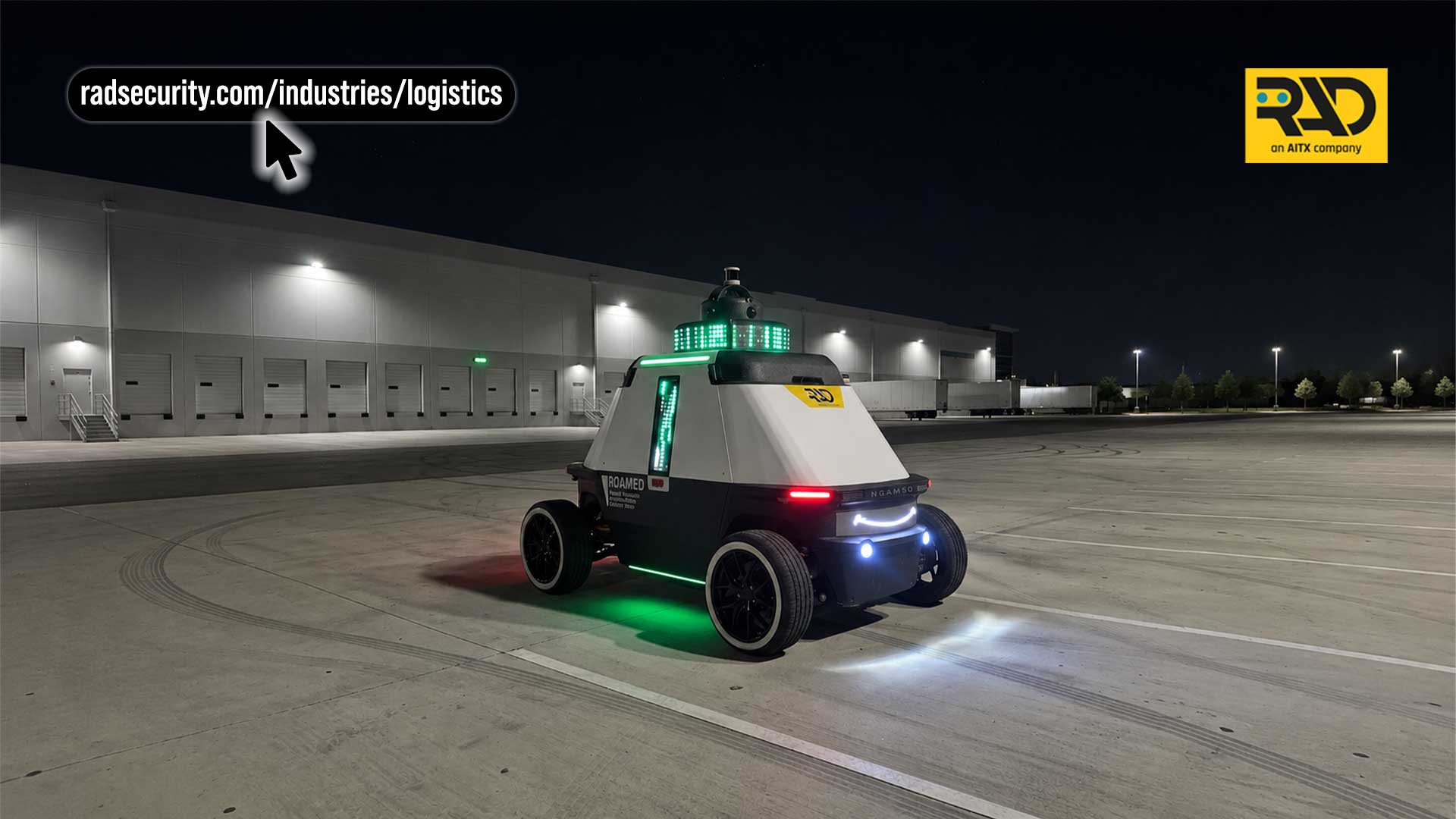
Physical AI closes that gap with presence that moves. RAD's ROAMEO Physical AI extends security presence into the spaces fixed cameras and sequential patrols miss. It's an autonomous patrol robot that handles slopes, curbs, and uneven terrain, using a fusion of LiDAR, radar, ultrasonic, and vision sensors for 360-degree awareness and edge AI for navigation and real-time decisions. It monitors routes for unauthorized access and perimeter breaches, provides visible deterrence, supports live two-way voice, and escalates verified events. ROAMEO Physical AI also reduces how often a person has to be the first body in an uncertain situation, since it can establish presence and open communication before a human responder steps in. For a site where coverage gaps come from distance, timing, and competing priorities, that's a meaningful operational shift.
The Response Layer: Agentic AI That Runs the Incident
Every layer above produces a verified event, but something still has to run the incident itself. That's the job most security programs handle manually, and it's precisely where time gets lost.
SARA Agentic AI, RAD's autonomous operator, runs the full lifecycle autonomously across connected RAD devices and onboarded third-party cameras, covering detection, verification, deterrence, escalation, response, and resolution. Its verification layer is the part logistics leaders should care about most, because SARA evaluates visual context, checks adjacent camera views, applies behavioral patterns, and enforces defined policies to filter non-events before they ever reach a human. That's the direct antidote to the false-alarm fatigue that quietly kills most analytics deployments.
"For years, the camera was a forensic tool. You found out what happened after it already cost you. Agentic AI changes the entire equation. The system sees the event, understands whether it matters, and acts on it in real time, the same way at every site. That's the shift our largest logistics clients made, and it's why they keep expanding with us." — Steve Reinharz, CEO/CTO & Founder, RAD
What makes that verification credible is how SARA was built. RAD engineered it specifically for physical security, training it on real security footage instead of the internet images general-purpose models rely on, so it reads context rather than just labeling motion. Its multi-agent design runs specialized agents that check each other's conclusions before acting, which is what lets it filter non-events with a consistency single-model systems can't match. Monitoring centers that have adopted SARA report measurable reductions in false alarms and faster incident verification, and RAD documents the full build in its Inside SARA white paper.
That work has been recognized at the SIA New Products and Solutions Awards in back-to-back years. SARA took the 2025 Judges' Choice Award and Best in Threat Detection and Response Solutions, then won 2026 Best in Commercial Monitoring Solutions for SARA operating inside Immix, a deployment that runs its verification and escalation directly within the workflow platform many commercial central stations already use. For a logistics operation that monitors through a central station or an in-house SOC, that 2026 award recognizes the exact shift this article is about: events handled in parallel instead of queued for sequential human review.
When human intervention is required, SARA notifies stakeholders in parallel, streams live video and context so responders arrive informed, and generates a complete, time-stamped, audit-ready report covering the full incident, which is the defensible record compliance teams and insurers expect.
RADSOC ties it together by surfacing patrol activity, incident logs, device status, and alert history across the entire deployment for centralized monitoring and historical analysis. Together, SARA and RADSOC turn individual detections into one coordinated workflow, and they give a global team a single, consistent operating picture across every site.
The Standard: Detection to Resolution
For an enterprise logistics security team, the real measure of an AI system isn't how many alerts it generates. It's how quickly it moves an event through the full progression, from detection that identifies the activity, to verification that decides whether it matters and filters out the noise, to deterrence that creates an immediate onsite response and resolves most incidents on the spot, to escalation that reaches the right people with context, to response that supports them while the event is still unfolding, and finally to resolution that documents the outcome so performance can be reviewed, accountability proven, and the operation improved.
That progression matters because in logistics, risk rarely stays put. A gate exception becomes a yard problem, a perimeter event becomes a trailer-theft attempt, and loitering in a lot becomes a building-access concern. A national security team can't manage that with informal processes, disconnected camera views, and inconsistent escalation paths. It needs one model that applies across facilities while still adapting to how each site runs.
That's what the four layers deliver together. AI analytics to see, Edge AI to act locally and instantly, Physical AI to cover the ground in between, and Agentic AI to run the response and standardize it across the property. The goal was never to see more. It's to respond faster, depend less on manual follow-up, and run a consistent operation across every site.
See how RAD moves logistics facilities from detection to resolution, and the response-time standard sites should be held to. Talk with our team.