

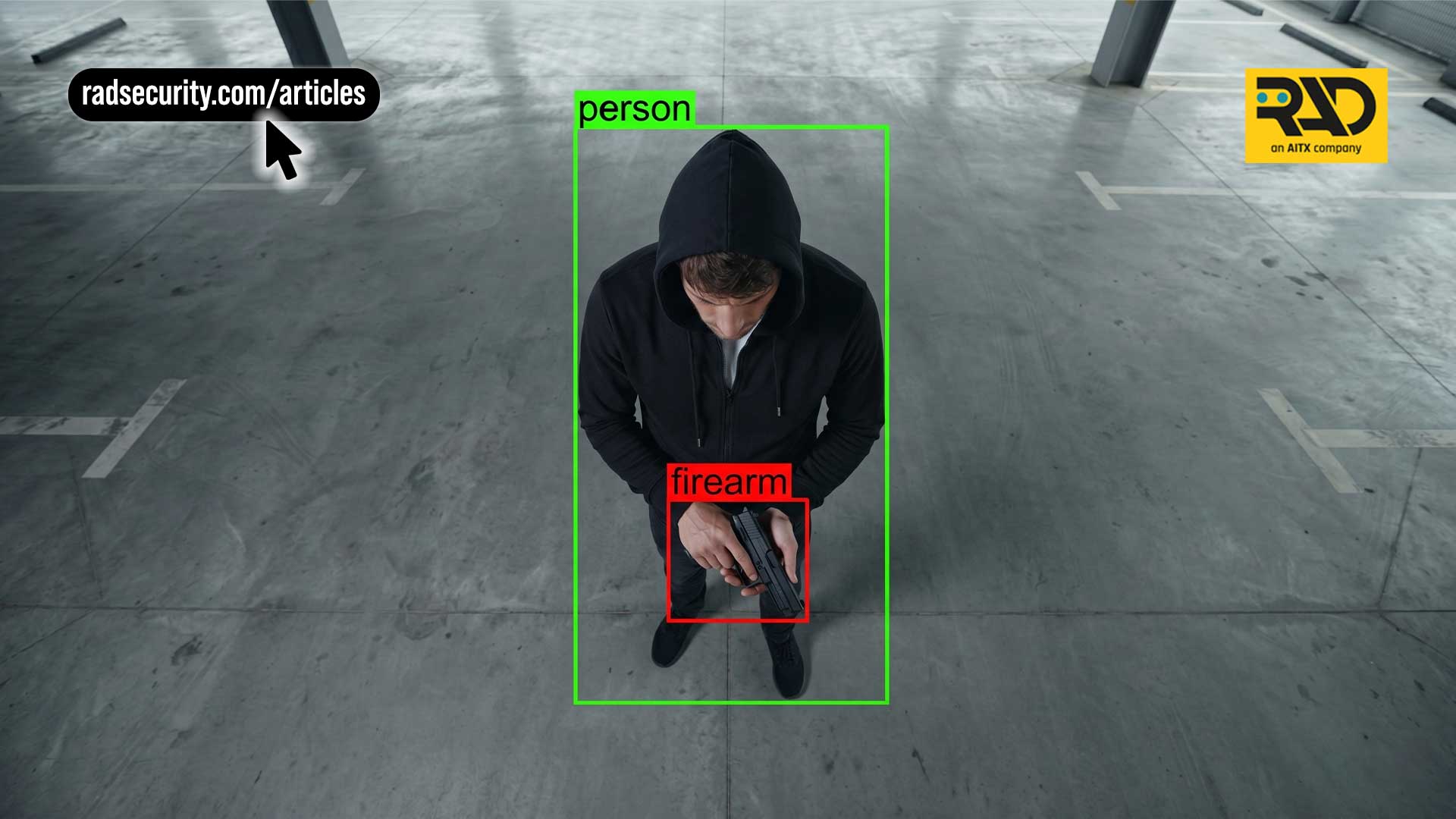
A weapon appears in the parking garage at 6:40 pm, drawn and in plain view, well before anyone fires a shot. That short window, between the weapon showing and the first round, is where a response can still change the outcome. What a site can do with it is the whole question.
Before The Shot
Firearm detection is an AI analytic that can run on most ONVIF Profile-S cameras, which significantly lowers the barrier to entry. By avoiding rip and replace, organizations can add new capabilities to existing assets already installed and deployed where they're needed.
When enabled, the analytic looks for brandished firearms, weapons drawn or carried in plain view, and flags them the moment they appear. In most incidents that's seconds to minutes before the first shot, which is the window where a response can still make a difference.
This is what separates firearm detection from gunshot detection. Gunshot detection is acoustic and registers a round that's already been fired, confirming the threat only after it's underway. Firearm detection works earlier, looking for weapons before they're used.
Half A Solution
Firearm detection provides real value, but on its own it's only half the solution. The other half is what happens in the seconds after the alert.
In most operations, that alert lands in a queue. Someone reads it, decides whether it's real, picks up a phone, and starts working a list one call at a time, under pressure and at the worst possible moment. A detection waiting in a queue works against the clock, because every second spent confirming and notifying is a second taken from the response.
Most of the industry stops there. It detects the weapon, verifies it by routing the frame to a remote center where a human confirms the threat, then notifies the security team with the alert, the image, and the location and leaves them to act. That's a fast handoff, but it's still a handoff into the same queue, and it puts the hardest part back on a person at the worst possible time.
The Operator Acts
Steve Reinharz, who founded Robotic Assistance Devices, puts it plainly.
"Detecting a weapon is important, but the question every security leader should ask is what happens in the next ten seconds. If the answer is that someone gets an alert and has to decide what to do, you still have the same gap you started with. We built SARA to close it."
Steve Reinharz, Founder and CEO, Robotic Assistance Devices
Firearm detection is one analytic in RAD's AI analytics library, which also covers perimeter intrusion, loitering, tailgating, vehicle, and PPE detection, so a site adds a capability to a system already watching the rest of the property rather than buying a standalone gun-detection box.
What makes the detection actionable is SARA, RAD's agentic AI operator. When a brandished weapon is detected, SARA verifies it in real time, so nothing waits in a queue for a remote analyst. Once the threat is confirmed, she reaches up to three stakeholders at once by call, text, and email in parallel, so the right people learn what's happening in the same few seconds.
That parallel escalation feeds everything downstream. Faster notification compresses the time to trigger lockdown and the rest of the site's response plan, and while that's happening SARA engages on-site with a voice-down and records every step in RADSOC from detection through resolution.
Closing The Gap
A brandished weapon gives a site a warning before the first shot, and the only thing that decides the outcome is whether anyone can act on it in time.
That's the gap SARA was built to close. The weapon is seen the moment it appears, verified in real time, and answered while the window is still open, on the cameras a site already owns. The warning stops being something a team watches go by and becomes something it acts on before the threat becomes a shooting.
Frequently Asked Questions
How does AI firearm detection work?
It analyzes live video from existing IP cameras and watches for the visual signature of a brandished firearm, flagging the weapon the moment it appears so a response can begin while the threat is still developing, before a shot is fired.
Can firearm detection run on existing security cameras?
Yes, and that's much of what makes it affordable. RAD's firearm detection runs on most ONVIF Profile-S cameras a site already has, which covers the bulk of commercial IP camera deployments, so adding the capability doesn't require replacing the camera infrastructure.
What's the difference between firearm detection and gunshot detection?
Firearm detection is visual and proactive, identifying a brandished weapon before a shot is fired. Gunshot detection is acoustic and reactive, registering a round that's already been fired. The practical difference is the intervention window, where deterrence and lockdown can still change the outcome.
What happens after a firearm is detected?
With SARA, verification happens in real time rather than waiting in a queue, and the incident escalates to up to three stakeholders in parallel by call, text, and email. That speed supports faster lockdown and SOP execution, while on-site voice-down deterrence begins and the full incident is documented in RADSOC through resolution.