

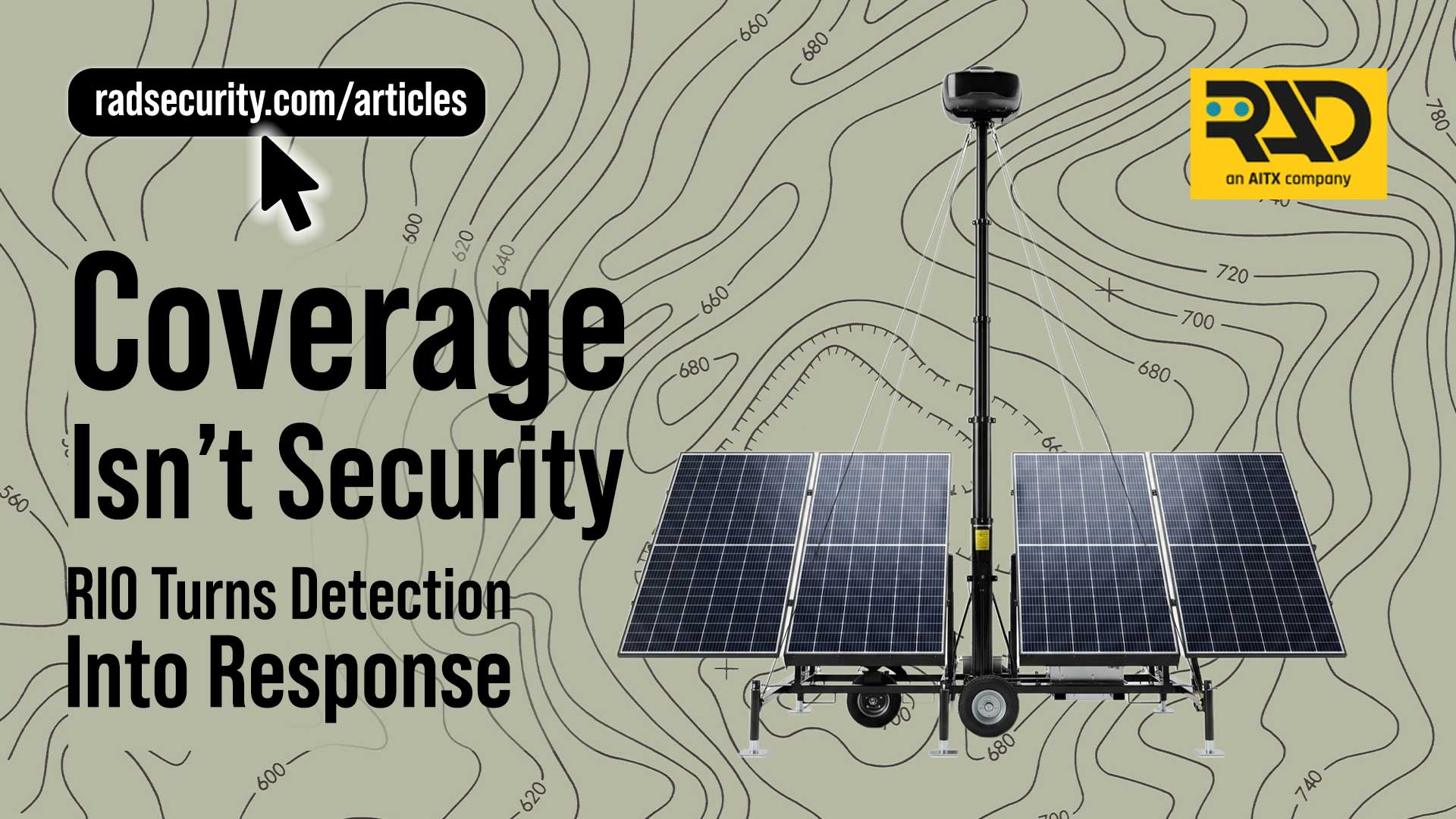
The problem with most mobile video surveillance systems isn't the camera. It's what happens after the system sees something.
Security managers protecting construction sites, storage yards, and temporary sites all face the same core challenge: the site has risk, but it doesn't have infrastructure. When security cameras depend on fixed infrastructure, they can't protect what they can't reach.
Outfitting security cameras with solar panels, a mast, and cellular connectivity solved part of that problem. They made it possible to have video feeds at remote locations, beyond the local area network, avoiding costly trenching and the complexity of long-range point-to-point systems. In those environments, that matters.
But coverage isn't the same as security.
Most mobile video surveillance systems deliver the basics: motion detection, live video streams, maybe some AI detection features, and an alert routed to someone responsible for reviewing it. Some systems are professionally monitored by remote video monitoring centers, where an operator eventually pulls the alert from a queue and decides what to do next. However, in many cases, by the time someone acts, the deterrence window may already be closed. The intruder is gone. The damage is done.
That's the gap most mobile security trailers still don't close.
Network, Power and Storage Challenges
Camera Infrastructure Evolved
Traditional CCTV systems ran on coaxial cable. Analog system cameras could cover distance, but they delivered poor video quality: grainy, low-resolution footage that struggled to identify a person at 20 feet away. CCTV cameras worked well in fixed facilities with dedicated analog system infrastructure. They weren't built to follow risk across a site that changes, and their video quality made incident review unreliable even when they did capture something.
IP cameras brought high-definition quality and network integration that analog system hardware couldn't deliver. The improvement in video quality was significant. But Power-Over-Ethernet technology introduced a new constraint: IP cameras were now limited to roughly 100 meters of cable run. Extending coverage to any location outside existing network infrastructure became a significant challenge. The CCTV cameras and fixed cameras that worked inside a building had no practical path to a remote yard without CAT-5 wiring, additional switching hardware, and significant cost.
Wi-Fi appeared to offer a solution, but commercial security cameras still require power regardless of network connectivity. Solving both power and signal without running cable means a switch, a PoE injector, and a wireless access point at each camera location, which is cost-prohibitive at scale and unreliable in outdoor environments. Point-to-point wireless systems are a legitimate answer for building-to-building coverage, but they're expensive per camera, require line-of-sight alignment, and need re-engineering every time the coverage zone shifts. For construction sites, storage yards, and temporary lots where the work moves and the site changes, that adds more friction than it removes. The only remaining option was trenching new conduit and absorbing the cost. On a site that moves in three months, no one has the appetite for it.
That's the problem mobile video surveillance systems were built to solve.
Cellular Connectivity
Cellular-connected mobile security trailers simplified the model. Instead of forcing camera infrastructure back to a building network, the trailer brings power, connectivity, and coverage to the remote location where risk exists. Connectivity through 4G LTE or 5G means the trailer operates wherever there's cellular signal, with no IT involvement, no network closet, and no cable run required.
Solar Power
Once connectivity is handled, the next constraint is power. Remote uptime isn't only about panel size or battery capacity. It's about how the entire system is built.
Purpose-Built Architecture Matters For Power
Many off-grid security deployments are assembled from separate components: cameras, cellular modems, solar panels, batteries, video management software, deterrence hardware, and monitoring tools. Each part may work on its own, but the full system doesn't always operate as one coordinated platform. That matters when sunlight drops, activity increases, or the site needs to run through winter weather without manual intervention.
Power consumption across a bolted-on system is difficult to optimize because the components weren't designed to work together. Cameras, cellular modems, edge compute, speakers, LED displays, and lighting all draw from the same power budget independently. Without platform-level energy management systems, power management becomes reactive: load is shed only when the system has to, rather than balancing power consumption intelligently across all components. That gap shows up in shortened battery cycles, unpredictable shutdowns, and sites that go dark when they need coverage most.
Why Bolted-On Surveillance Trailers Lose Efficiency
Purpose-built architecture changes the equation.
RIO is built around RAD's own security architecture, including RADPack, NVIDIA-enabled Edge AI processing, integrated LED or ribbon lights, a 110 dB loudspeaker, microphones, two-way audio, and cloud management through RADSOC. Every core function, from power and video to deterrence, alerts, and remote management, is designed to operate as one coordinated platform, not a stack of competing add-ons.
That integration makes energy management more effective. Power consumption is managed at the platform level, not component by component. The result is a system designed to stay online under real operating conditions, reducing the reliance on generator backup or manual power workarounds when sunlight is limited.
For security teams, that’s the baseline that matters: not just whether the system has solar panels, but whether the platform is optimized to detect, deter, communicate, and stay online when the site needs it most.
Video Feeds Need A Reliable Storage Strategy
On remote sites, video storage has to work without a wired backhaul or perfect cloud connection at every moment of the day. Cellular connectivity through 4G LTE or 5G can support remote security operations, but no serious deployment should assume the link will be flawless every second. Weather, carrier conditions, site activity, and bandwidth demand can all affect how video moves from the device to the cloud.
That's why storage strategy matters in any mobile video surveillance system.
Local Retention Protects The Incident Record
A remote video surveillance system needs enough local storage to preserve video at the device, while still giving the security team access to events, alerts, and incident records through a cloud management platform. The goal isn't to push every frame across cellular networks in real time. The goal is to retain the right footage, make verified events easy to review, and keep the incident record available when it matters.
This is another area where purpose-built architecture matters. In a bolted-on system, storage may be treated as a camera feature, a recorder setting, or a cloud storage subscription decision. In a commercial remote deployment, storage has to be part of the full operating model: video capture, event tagging, alert review, incident documentation, and remote access all need to work together.
RIO is designed around that model. It supports 24/7 onboard video retention for 21 days, giving teams a local record at the device while RADSOC provides a cloud-based system for live views, alerts, footage review, and incident activity.
For security teams, video storage shouldn't be an afterthought. It's what turns detection into evidence, review, reporting, and resolution. A mobile video surveillance system that loses the record during a connectivity gap hasn't solved the remote site problem. It has only moved the failure point.
The Real Question Is What The Camera Does Next
A mobile video surveillance system can record activity and send alerts. That solves coverage. It doesn't automatically solve security.
False Alarms Create Response Delay
This is one of the biggest challenges with many mobile security trailers. They generate too many false alarms and too many low-value motion events. Headlights, wind, shadows, animals, passing vehicles, and routine site activity can all create noise. The result is a flood of alerts that someone still has to review, verify, and prioritize. A high false alarm rate isn't just an inconvenience. It's an operational failure that trains operators to ignore the system.
For remote sites, that delay matters. If every motion event becomes an alert, the deterrence window may close before anyone confirms what happened. The trailer captures useful footage, but the opportunity to interrupt the incident is already gone.
That's why the real question isn't whether a system can detect motion. It's whether it can identify activity that matters and respond while the person is still on site.
Edge AI: RAD's Analytic Library
Edge AI analytics help solve the false alarm problem by moving detection closer to the event. RAD’s analytic library runs on NVIDIA-enabled processing hardware built into RIO 180 and RIO 360, using AI video surveillance to classify activity against defined detection rules instead of flagging every motion trigger.
The intelligent algorithms behind the platform use machine learning, object classification, and movement pattern recognition to separate meaningful activity from routine motion. The result is smart detection that filters what matters before an alert ever leaves the device.
For mobile video surveillance systems, that distinction matters. A basic motion alert tells the security team something moved. RIO’s Edge AI helps determine whether the activity is relevant, whether it matches the site’s rules, and whether it should trigger a response.
Human Detection
Human Detection identifies individuals moving through monitored areas, including during low-light and off-hours conditions. It supports the use cases that matter most on remote sites: unauthorized entry, perimeter intrusion, loitering, and tailgating.
That context is important. A person briefly passing through an approved area during working hours is different from someone lingering near equipment after dark or crossing a restricted boundary. RIO’s AI detection helps separate routine movement from behavior that may require deterrence or escalation.
Vehicle Detection
Vehicle Detection tracks vehicles moving through entry points, parking areas, lanes, and sensitive zones. For remote sites, vehicle activity often matters as much as pedestrian activity. A truck stopping near a gate, a vehicle entering after hours, or repeated movement near stored assets can all signal risk.
When configured for the right view, RIO can also support License Plate Recognition, capturing and logging plate data for review and investigation. That gives the security team better context when vehicle activity becomes part of an incident record.
Object Detection
Object Detection supports security and safety use cases that go beyond basic intrusion. Firearm Detection recognizes the visible presence of a weapon and can trigger immediate escalation. PPE Detection identifies whether individuals are wearing required safety gear, including hard hats, vests, and other compliance equipment.
This expands RIO’s value beyond after-hours security. During the working day, PPE Detection can help document safety compliance, support audits, and give site teams visibility into behavior that would otherwise require manual review.
From Motion Alerts To Verified Events
Each detection is evaluated against site rules before a response is triggered. That step addresses one of the core failures of many mobile surveillance units: an unverified alert is just another item in a queue. A qualified detection is an event that can trigger immediate response.
Artificial intelligence running at the edge helps reduce the false alarm rate before events reach the security team. Key stakeholders review surveillance video that has already been filtered for relevance instead of manually sorting through every motion event to find the one that matters.
Machine learning helps RIO classify visual events at the edge, while onboard microphones support two-way audio recordings and live interaction during an incident. Digital signal processing improves clarity so voice-downs and responses can be heard more clearly in real time.
In RIO, AI video surveillance happens at the edge. Video streams are analyzed before they’re forwarded or escalated, helping the security team review signal instead of noise.
From Coverage To Real-Time Response
Verified detection matters, but detection alone doesn’t stop an incident. The question isn’t whether the system saw what happened. It’s whether the system did something about it while the person was still on site.
Most mobile surveillance units are designed to be seen, not to act. Strobe lights and loud sirens deliver a generic response that may interrupt activity in the short term. Over time, they get habituated.
If a siren sounds for every motion event, intruders learn to wait it out. If a strobe activates repeatedly without context, it becomes background noise. When the response is identical regardless of what’s actually happening on site, it stops functioning as deterrence and becomes another predictable part of the environment.
Edge Deterrence Changes Behavior On Site
RIO’s response is calibrated to what’s actually happening. When detected activity matches a defined site rule, RIO responds immediately with visible and audible deterrence: integrated LED or ribbon lights, a 110 dB loudspeaker, voice commands, and two-way audio. The response happens at the point of activity, while the event is still unfolding.
There’s no queue. There’s no operator reviewing footage before deciding whether to trigger a response. Verified detection triggers immediate action.
A person testing a site wants to know whether it’s monitored, whether anyone will act, and how much time they have. An immediate, visible, audible response answers those questions before they’ve had time to evaluate. If behavior changes and the person leaves, the system has done its job.
If it doesn’t, there’s a next layer.
Where Agentic AI Fits In Remote Video Monitoring
Some incidents need more than automated deterrence. A person may ignore the first voice-down. A vehicle may remain near a gate. Someone may keep moving after hours toward equipment or a restricted area. A perimeter breach may need escalation to a security manager, monitoring team, or law enforcement with enough context to act. These situations require intelligence, not just volume.
That's where traditional remote video monitoring often slows down. Even real-time video monitoring creates a bottleneck when every event still depends on a human queue. Alerts land in order. Operators review surveillance video one at a time. Escalation depends on who sees the alert, how quickly they understand the scene, and whether they can reach the right contact before the situation changes.
SARA Agentic AI removes that bottleneck. With SARA Agent active, RIO moves into full security incident response orchestration. SARA uses the live video feed to verify what’s happening and deliver a response based on what the surveillance cameras are actually showing, not a generic alarm. SARA uses the live video feed for incident context, while RIO’s two-way audio and onboard microphones support live interaction during the event. Digital signal processing improves clarity so voice-downs and responses can be heard more clearly in real time.
The difference is specificity. Most automated warnings play the same message every time regardless of what's happening on site. A generic warning tells someone a system exists. SARA tells them they've been seen. Instead of a repeated tone, the person hears something tied to their actual behavior: that they're near the gate, standing by a vehicle, approaching stored equipment, or lingering in a restricted area. That specificity breaks anonymity. It signals that the event has been seen, understood, and is being acted on in real time. That creates a different response, one that strobe lights and loud sirens can't replicate.
Human-Like Talk-Downs Improve Deterrence
Deterrence isn't just about volume. It's about perception. An intruder is trying to determine whether the site is truly monitored, whether anyone is paying attention, and whether they have enough time to continue. A human-like talk-down that describes specific behavior on screen signals that the answer to all three is no.
If the activity stops, the system has changed the outcome. If it continues, SARA escalates while the event is still active rather than waiting for a review queue to catch up. SARA contacts stakeholders in parallel, provides live scene updates, and documents the incident as it unfolds.
When escalation requires law enforcement, SARA can contact designated law enforcement numbers through pre-programmed escalation protocols. Responding contacts receive a verified incident with a live feed and a documented event already in progress. That’s actionable intelligence, not a notification.
Security Incident Response Orchestration Without The Queue
The goal isn’t to replace every human decision. It’s to reduce the delay between detection, orchestration, and resolution. For remote sites, that delay is often where incidents get expensive.
A surveillance camera can show that something happened. A responsive security platform can influence what happens next.
RIO In The Field
RIO is built for remote sites where fixed infrastructure isn’t practical: construction sites, storage yards, utility properties, parking lots, laydown areas, and temporary locations.
The deployment model is simple. Place RIO where coverage is needed, manage it through RADSOC, and adjust the deployment as site conditions change.
That’s the practical value of a mobile security trailer: it brings detection, deterrence, escalation, and incident documentation to the location where risk exists without turning every new exposure point into an infrastructure project.
RIO Mini, RIO 180, And RIO 360
RIO is available in configurations designed for different coverage requirements, budgets, and site assessments. RIO Mini provides compact 360° coverage and cost-efficient deterrence for focused areas. It supports core AI analytics, including human detection, perimeter intrusion, loitering, PPE detection, and vehicle detection, with automatic talk-downs and visible deterrence through ribbon lights.
RIO 180 is built for directional coverage across entry points, lanes, corridors, gates, and defined access paths. With NVIDIA-enabled Edge AI processing, it supports the full analytics set, including firearm detection, license plate recognition, and core detection features, with faster on-device detection and response.
RIO 360 is the higher-capability option for larger remote sites that need complete 360° coverage and maximum onboard response. It supports full AI analytics, including firearm detection, license plate recognition, and advanced detection features, with NVIDIA-enabled Edge AI processing for faster detection and response across broader site coverage.
Each configuration is designed to match the site profile. A focused risk area may call for compact 360° deterrence. A gate, lane, or corridor may call for directional coverage. A larger equipment yard, construction site, utility property, or parking area may call for full 360° visibility with maximum detection and response capability.
That is where site assessment and risk analysis matter. The goal is to match coverage, analytics, deterrence, and escalation to the way the site actually operates.
For security teams, that is the difference between a camera deployment and a remote security operation.
The Bar Has Moved
The conversation about remote site security has shifted. Solar panels, cellular connectivity, video storage, weather-ready hardware, and motion detection used to define the upper end of what a site without infrastructure could expect. That’s no longer the case. Those capabilities are now the floor.
The next phase is about response.
A serious remote security deployment has to do more than get video from a remote site to a screen. It has to detect what matters, deter while the incident is active, orchestrate escalation, and support resolution before the loss is already done.
The differentiator isn’t the spec sheet. It’s whether the system acts when it sees something or only records what it saw.
That’s the line between coverage and security.
From Mobile Video Surveillance To Autonomous Security
The next baseline for remote site security is response.
A system built around passive detection still depends on someone manually reviewing alerts, understanding whether the activity matters, and deciding whether there’s enough information to escalate. That process can work when volume is low and timing is perfect. Remote sites rarely give security teams that luxury.
That’s where autonomous security changes the model. Instead of treating detection as the finish line, it treats detection as the start of the incident workflow. The system identifies what’s happening, acts while the incident is still active, escalates when needed, and preserves the record for review after the fact.
The buying criteria has changed. Security teams aren’t just evaluating how much a system can see. They’re evaluating how much work the system can take off their plate once something happens.
How much has to be reviewed manually? How much depends on someone catching the alert at the right time? How much of the response is automatic, consistent, documented, and repeatable?
That’s the shift from manual review to autonomous response.