Security trailers have long promised enhanced visibility with cameras, flashing lights, and loudspeakers, often deployed quickly to fill infrastructure gaps. However, visibility alone has proven insufficient for true security resolution.
For years, most mobile security units recorded incidents more often than they resolved them, frequently serving as motion-activated archives of events already in progress.
Even competing "smart" trailers typically rely on remote operators managing multiple sites, leading to an overload of alerts and numerous false alarms. Verified events often languish in queues, waiting for human intervention.
This reliance on human attention often results in missed incidents and a false sense of security, limited by the capacity and vigilance of individual operators.
The Foundation: Autonomous Intelligent Response
The introduction of Autonomous Intelligent Response (AIR™) fundamentally shifted this paradigm. Even before the advanced capabilities of Agentic AI, RAD’s RIO 360 already distinguished itself by acting without requiring immediate human confirmation.
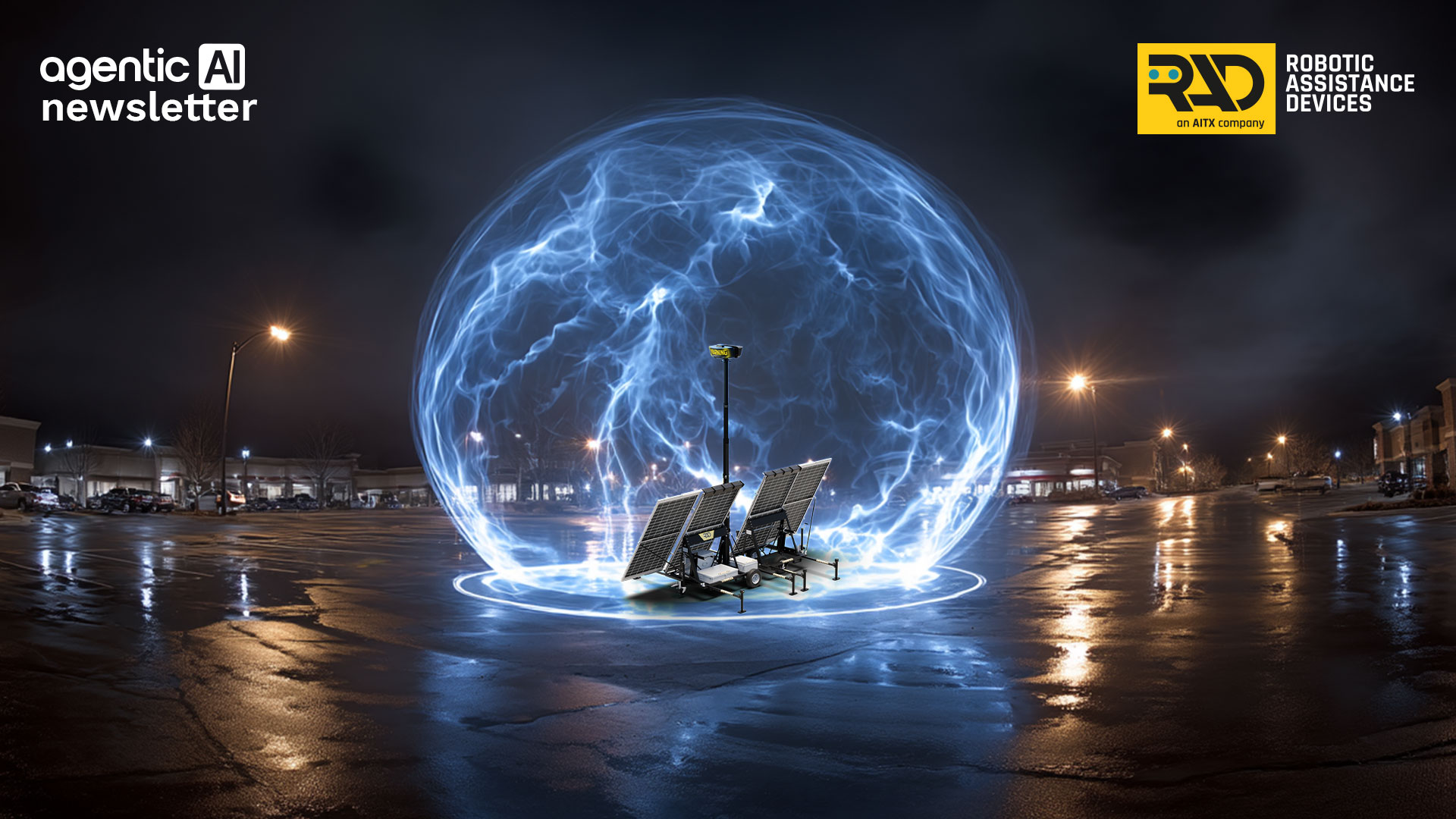
Equipped with four high-definition sensors, the RIO 360 provides true 360° coverage and onboard deterrence systems capable of issuing immediate warnings upon activity detection. This demonstrated that mobile security could respond instantaneously to unfolding events.
This foundational concept of instantaneous response at the edge paved the way for Agentic AI to later expand into comprehensive security incident orchestration.
Real World Applications
Today, the synergy of RIO 360 and SARA Agentic AI marks a significant advancement in autonomous security, offering a robust system that processes at the edge and orchestrates seamlessly in the cloud.
The RIO 360 trailer utilizes NVIDIA edge-based processing, enabling real-time analysis of every camera feed. This local intelligence ensures immediate awareness, eliminates lag, and removes dependency on remote connectivity for detection or deterrence.
It identifies motion, classifies objects, and verifies behavior within milliseconds, providing rapid, localized threat assessment.
Concurrently, the SARA Agentic AI operator, functioning within the cloud, monitors the entire orchestration layer. Upon verification of an event that meets escalation criteria, SARA autonomously intervenes.
She issues natural, human-like voice-downs via the RIO 360’s speaker array, delivering clear verbal commands while simultaneously coordinating with stakeholders across the network.
This innovative dual-layer architecture provides the RIO 360 with optimal capabilities. Edge AI facilitates split-second detection and response, while Agentic AI cloud-based orchestration ensures comprehensive situational coordination, recording, and communication.
Together, they form a seamless incident chain specifically engineered for real-time security responses.
Detection in Context
While legacy motion analytics frequently interpret every movement as a potential threat, Agentic AI intelligently filters these signals through contextual understanding.
Leveraging its onboard processing, RIO 360 accurately distinguishes between people, vehicles, and environmental motion. This nuanced understanding prevents routine activities from being flagged as suspicious, significantly reducing false alarms and focusing attention on genuine threats.
Every detection event is immediately relayed to SARA, which concurrently confirms the verification chain, eliminating operator queues and delays.
Verification and Deterrence
Once an event is verified, immediate deterrence protocols are initiated. SARA utilizes RIO 360’s integrated audio and visual systems to directly engage with the subject.
SARA communicates in natural language, adapting her tone based on observed behavior. Simultaneously, lights flash, strobes activate, and a sequence of escalating commands warns intruders of active monitoring and recording.
The speed of this deterrence sequence is paramount, with SARA initiating actions before a human operator could even react. This ensures that incidents which might otherwise unfold for minutes are resolved in mere seconds.
Escalation in Parallel
While SARA manages deterrence, she concurrently initiates live escalation protocols. Up to three key stakeholders—including security personnel, property management, or designated response teams—receive simultaneous calls or alerts.
Each stakeholder is provided with live updates and can interact directly through SARA, receiving instant answers to questions. The system delivers current video snapshots, event summaries, and real-time next-step guidance.
This simultaneous coordination transforms the trailer from a mere notification system into an active director of the response.
Coordinated Response
Once escalation is underway, SARA proficiently manages the scene, maintaining live communication with responding personnel. She provides crucial updates, directions, and situational awareness, ensuring responders do not enter the scene unprepared.
Throughout an active response, SARA continuously verifies conditions via RIO 360’s sensors, confirming the effectiveness of deterrence or identifying changes in the situation.
This vital feedback loop empowers human responders to act decisively, while SARA diligently maintains visibility and comprehensive documentation. This coordination transforms an automated alert into a fully managed incident.
It represents more than mere escalation; it is a guided response delivered in real-time.
Resolution and Documentation
From the initial trigger to the final outcome, every single action is meticulously logged. Detection data, verification results, audio recordings, and escalation timelines are automatically compiled into a detailed incident report.
This comprehensive record effectively closes the loop for compliance, insurance, and operational review processes. What previously required hours to reconstruct can now be assembled in minutes.
This is precisely how Agentic AI transforms static footage into a complete incident lifecycle, encompassing detection, verification, deterrence, escalation, response, and resolution, all orchestrated autonomously.
The Outcome
This innovation fundamentally shifts mobile security from mere footage capture to proactive resolution. With RIO 360 and SARA Agentic AI operating in tandem, every site essentially gains an autonomous command post that sees in every direction, thinks at the edge, and communicates through the cloud.
The system responds with a speed unmatched by any human operator, while still maintaining essential human oversight where policy dictates. The ultimate outcome is security that scales, continuously learns, and acts decisively in real time, establishing an entirely new standard for mobile protection.
Closing Thought
True security is not merely measured by coverage, but by its effective performance during critical moments. Security incident orchestration makes this level of effectiveness genuinely possible.
David Marsh, Vice President of Marketing at Robotic Assistance Devices, stated, "When detection through resolution align, results are faster, measurable, and defensible. Agentic AI brings that orchestration to mobile security. Each trailer can act, communicate, and verify in real time, turning visibility into resolution."