
Why Solar Fields Are Difficult To Secure
Solar installations present a unique convergence of conditions that sets them apart from most commercial or industrial properties.
They're built in remote areas with little natural surveillance. Critical assets, including cabling, inverters, and panel arrays, are spread across a footprint that can span hundreds of acres. Staffing after hours is minimal or nonexistent. During construction or expansion, large quantities of high-value materials are staged on-site, often before perimeter infrastructure is fully in place.
For security teams, this creates a persistent operational problem. An alert may come in, but the people responsible for responding are offsite, managing multiple locations, or relying on fixed camera views that can't tell the full story. A sensor can flag movement and a camera can capture an image, but neither can move toward the event, verify it from another angle, or maintain an active presence on the ground while a remote team assesses the situation.
That's the real weakness most solar sites face. Not a lack of alerts, but the absence of fast, informed, on-site verification that makes those alerts actionable. Security teams managing multiple locations can't afford to respond to every ambiguous event, and when a system can't distinguish a genuine intrusion from a deer crossing the perimeter, credibility erodes and response times suffer.
The Real Risks At Large Solar Sites
The most immediate security risks at solar fields are practical, physical, and expensive. They're also increasingly well-documented across the United States. By industry estimates, solar farm theft has increased more than 300% over the past five years, and the pattern of incidents shows no sign of slowing [Mango Solutions, August 2025].
Copper and Cable Theft
Copper and cable theft remains one of the clearest and most costly threats facing remote energy infrastructure. Long perimeters, limited overnight activity, and exposed wiring create ideal conditions for organized criminal networks, and the financial impact is rarely limited to the value of what's taken.
In Fresno County, California, thieves stripped approximately $100,000 worth of copper wiring from a solar installation in a matter of hours. Once downtime, equipment repairs, and project delays were factored in, total estimated damages exceeded $2.8 million [Raptor Maps, April 2026]. In Johnston County, North Carolina, investigators discovered in September 2025 that thieves had removed copper wiring from multiple panels across a site, causing an estimated $200,000 in direct losses [Johnston County Report, September 2025]. In Richmond County, North Carolina, law enforcement documented more than 40 separate copper theft incidents at a single solar facility throughout 2025 before making arrests in early April 2026 [Richmond Observer, April 2026]. In Darlington County, South Carolina, deputies documented a series of solar farm thefts over two months, with thieves cutting through perimeter fencing to reach buried wiring at rural facilities before disappearing before response units arrived [Pro-Vigil, December 2025].
These aren't isolated cases. Copper hit an all-time high of $5.96 per pound in 2025, and recent tariff pressures are accelerating prices further [Yahoo Finance, December 2025]. Solar farms, with miles of accessible cabling across unmanned terrain, remain a primary and growing target. Once a site is hit, the risk doesn't drop. Industry data shows repeat targeting is common, with one facility suffering four separate incidents in a six-week window [WCCTV, June 2025].
Panel and Equipment Theft
Panels, inverters, and related equipment are increasingly targeted as well, particularly during construction, staging, or expansion phases. Organized operations typically remove between 100 and 300 panels per incident. In at least one documented case, over 15,000 panels were stripped from a single facility over a single weekend [Angelcam, September 2025].
In Pickaway County, Ohio, masked thieves were captured on a facility's own cameras loading solar panels into a vehicle at an active solar farm site in mid-2025. The suspects fled when additional vehicles approached, dropping panels in the process [Scioto Post via LinkedIn, June 2025]. The incident illustrates a pattern security operators know well: the cameras were there, the footage was clear, and the theft still happened because there was no active presence to interrupt it.
When assets are distributed across a large site, maintaining meaningful oversight with static infrastructure alone becomes difficult. The challenge isn't just detecting suspicious activity. It's verifying it quickly enough to stop losses before they scale.
Vandalism and Site Damage
Not every incident is motivated by financial gain. Vandalism, trespassing, and intentional damage can produce significant operational and financial consequences regardless of motive.
In New Gloucester, Maine, vandals used on-site construction equipment to rampage through a nearly completed community solar farm in July 2024, causing several hundred thousand dollars in damage and delaying the project significantly [RTO Insider, July 2024]. The site had limited overnight presence, and the damage was already done by the time deputies arrived the following morning.
Deliberate Intrusion and Sabotage
This isn't the most common day-to-day threat, but it belongs in the security picture, and it's no longer purely hypothetical. Solar farms classified as critical energy infrastructure face the same elevated threat environment as other grid assets, including the potential for targeted intrusion or intentional disruption designed to cause operational outages rather than financial gain. Passive alerting is particularly insufficient in these scenarios. The faster an operator can verify, escalate, and respond, the better the outcome.
What Autonomous Security Means
Autonomous security isn't a single product or a simple upgrade to existing cameras. It's a category of AI-driven systems, including fixed edge AI devices, mobile patrol platforms, and agentic AI orchestration software, that work together to extend real-time coverage, verify incidents without human dispatch, and coordinate response workflows across distributed environments.
In a solar security context, this typically involves three integrated capabilities.
Edge AI devices and intelligent cameras provide continuous perimeter intrusion detection at fixed points across the site. They analyze activity in real time, reduce false positives, and trigger verified alerts rather than raw motion events.
Autonomous mobile platforms, including AI patrol vehicles and mobile security towers, extend coverage beyond fixed infrastructure. They patrol service roads and equipment zones and can move toward active events to provide live verification and active deterrence.
An agentic AI security layer connects detection to action. It orchestrates escalation workflows, coordinates response across devices and teams, and ensures the right information reaches the right people in time to matter.
Together, these systems transform a passive alarm environment into an active response environment.
Where a Layered Autonomous Approach Fits
A strong solar security strategy doesn't depend on one device doing everything. It works best when different parts of the problem are addressed at different layers.
Persistent Perimeter Coverage
Fixed edge AI security devices like ROSA, developed by Robotic Assistance Devices (RAD), provide persistent 180-degree panoramic coverage at critical access points and equipment zones. Powered by NVIDIA Jetson edge AI, ROSA analyzes activity in real time, executing AI threat verification directly on the device without cloud dependency. When it detects unauthorized access, loitering, or suspicious activity, it doesn't wait for a human to respond. ROSA engages autonomously through integrated LED messaging displays and loudspeakers, issuing active warnings to deter intruders before an incident escalates. Designed for wall or pole-mounted deployment, it's well-suited for defined perimeter lines, gate approaches, and high-risk equipment zones across a solar field.
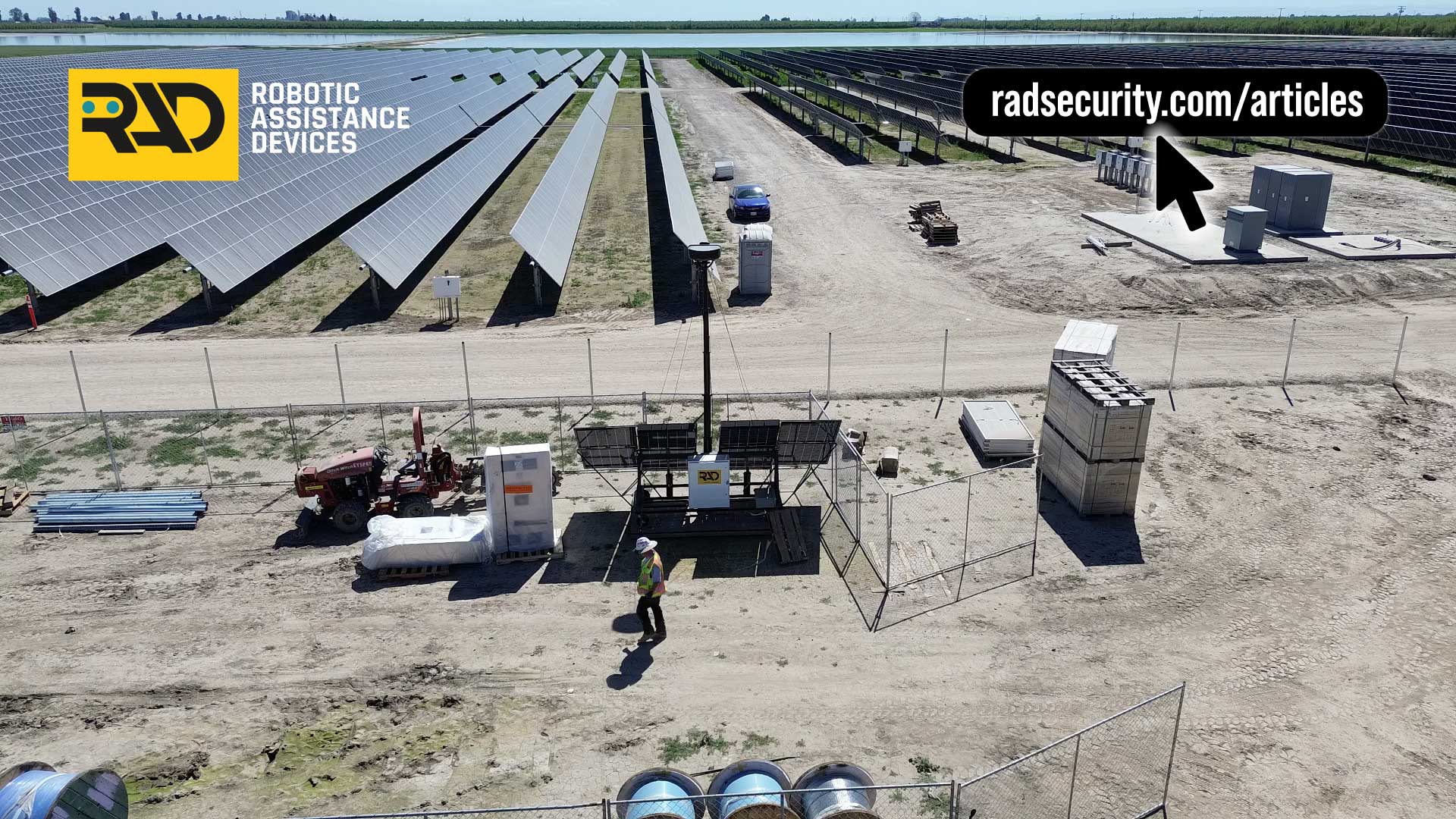
For sites in construction, expansion, or areas without permanent power infrastructure, RIO 360, RAD's solar-powered mobile security tower, brings the same capability to open terrain. Two ROSA units mounted atop the mast deliver complete 360-degree coverage, with NVIDIA Jetson edge AI running on both units simultaneously. The same active deterrence carries over as well, including LED ribbon lighting and loudspeakers on each unit, so the system can identify a threat and respond to it autonomously from any direction. Four 540W solar panels deliver 2,160W of completely off-grid power with no external infrastructure required. RIO 360 deploys in minutes, repositions as construction phases shift, and ensures coverage follows risk rather than fixed installation points.
Mobile Patrol and Verification
Fixed infrastructure covers known zones. ROAMEO, RAD's autonomous security patrol robot, covers the space between them.
ROAMEO functions as an AI patrol vehicle that executes programmed patrol routes across service roads, equipment staging areas, and remote zones that fall outside fixed camera coverage. When a perimeter alert triggers, ROAMEO can be dispatched immediately to verify the event, streaming live footage to an offsite security operations center before any human responder is in transit. That capability closes the verification gap between an alert and an informed response.
Intelligent Response Orchestration
Detection and mobile verification are only as effective as the response they enable. SARA, the Speaking Autonomous Responsive Agent, is RAD's agentic AI platform and the operational intelligence layer that connects everything else.
SARA Agentic AI functions as an autonomous incident response platform. It aggregates inputs from fixed sensors, mobile platforms, and edge devices, applies AI threat verification to distinguish genuine threats from false alarms, and executes security escalation workflow automation so the right teams receive the right information immediately. Rather than requiring an operator to manually triage every alert, SARA handles security incident response orchestration automatically, directing human attention toward confirmed, verified threats.
Access Control and Entry Management
For solar facilities with staffed entry points, equipment access roads, or substation gates, AVA, RAD's autonomous gate access system, provides AI gate access control without requiring a manned guard booth. AVA combines license plate recognition, automated visitor verification, and tailgating detection to manage site access with the same rigor a staffed entry point would provide, without the staffing overhead a manned booth requires.
Why Mobile Verification Changes the Equation
For large remote sites, the goal isn't only to detect activity or capture footage after the fact. It's to understand what's happening while there's still time to act.
The Pickaway County incident captures exactly why this matters. The cameras were rolling. The theft was on record. But there was no system that could move toward the event, challenge the intruders, or give an offsite team something to act on in real time. By the time anyone reviewed the footage, the opportunity to intervene had passed.
An autonomous security patrol robot changes that dynamic. When a perimeter event triggers at 2 a.m. on a 400-acre site, ROAMEO can be dispatched immediately, providing live confirmation of whether the alert is a credible intrusion, a false positive, or something in between. That information reaches the offsite team before a human responder is even in a vehicle.
The value isn't just better visibility. It's time. On a site where the difference between a verified intrusion and an ignored alert can mean $2.8 million in losses, time is the metric that matters most.
What to Look For in a Solar Security Strategy
For solar operators evaluating autonomous security systems, the most effective approach reflects the actual realities of the site. That means a strategy that can:
- Maintain persistent coverage across a large footprint without full-time staffing
- Provide mobile verification when fixed systems can't tell the full story
- Reduce false positives so response resources are directed toward real threats
- Support active deterrence, not just passive monitoring
- Operate in off-grid or infrastructure-limited environments during construction and expansion
- Coordinate detection, verification, and escalation through a unified AI-driven response workflow
- Adapt as site conditions, risk profiles, and asset locations change
That's where autonomous security systems have a clear and specific role. Not because they replace every other measure, but because they strengthen the part of the workflow that breaks down most often on remote properties: the critical window between knowing something may be wrong and being able to respond with confidence.
Closing Thought
Large solar fields don't just need detection. They need a security strategy that extends awareness, verification, and response across distance, continuously, and without a person standing at every point of risk.
Autonomous security makes that possible. It turns a remote site from a passive alarm environment into an active response environment, where offsite teams are better equipped to confirm threats, maintain presence, and act before loss escalates.
That's the real opportunity. For solar operators managing the realities of large-scale remote infrastructure, it's one that's increasingly difficult to address any other way.