

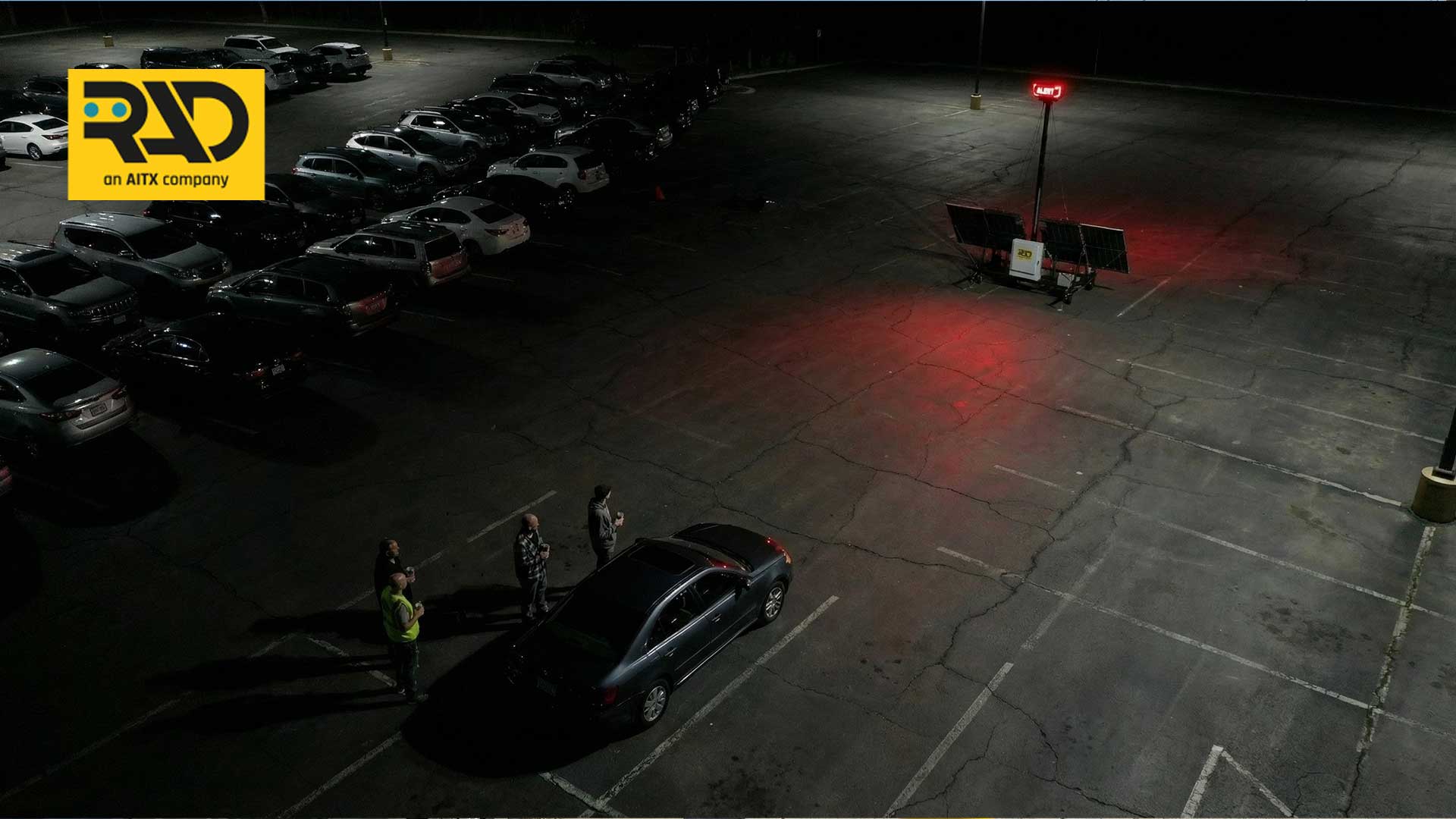
Parking lots are part of the workplace experience. On a large campus, they influence how secure employees feel after hours, how visitors experience the site, and how well the organization appears to control the property beyond the front door. That broader reality plays out every day in parking areas, campus pathways, access points, and exterior spaces that need to feel secure after dark.
The Challenge
Most parking lot incidents begin before the actual break-in. The pattern usually starts with lingering behavior that looks questionable before it becomes obviously criminal. Someone spends too much time between rows of vehicles. Someone circles the same section of the lot more than once. Someone peers into windows, checks handles, or stays too long near the edge of the property where foot traffic is low and visibility is thinner.
Parking environments also represent a meaningful security concern on their own. During the past five years, parking environments ranked third among locations where a violent offense occurred, accounting for 239,998 incidents between 2019 and 2024, according to the FBI’s Crime Data Explorer. That figure spans many kinds of parking settings, not just corporate campuses, but it reinforces a broader point security professionals already understand: parking lots are active risk environments that require more than passive monitoring.
Security teams often have cameras pointed in the right direction. The harder question is whether they can intervene before the incident matures. That gap becomes especially clear in parking lots, where suspicious lingering near vehicles or entrances can continue long enough for theft or vandalism to develop before anyone intervenes.
The Ripple Effect
A break-in affects more than the employee whose vehicle was hit. It changes how the campus feels.
Employees remember which areas feel exposed after dark. A visitor or vendor who sees broken glass in the lot forms an immediate impression about the site. Repeated incidents can quietly undermine confidence in the environment itself. That matters because a corporate campus is not just a collection of buildings. It is also a daily arrival point, a departure point, and a signal to employees and guests about whether the environment feels controlled.
Parking lot safety and security carries business consequences that won’t show up neatly in an incident log. A workplace that feels exposed after dark can affect employee confidence, shape how visitors perceive the company, and raise broader concerns about duty of care. That’s part of why parking lot protection deserves more than passive observation.
The Monitoring Gap
Recorded footage can help explain what happened. It rarely changes what happens next.
A patrol officer may pass through the lot too early or too late. An operator may receive an alert but still need to assess the scene, verify the activity, and decide how to escalate. That delay matters. By the time the event is confirmed, the suspect may already have moved from suspicious behavior to theft or vandalism.
The issue usually isn’t visibility alone. The issue is the gap between detection and action.
That gap becomes even more obvious on large campuses at night. Parking areas stretch across broad spaces. Lighting conditions vary. Pedestrian activity drops. A suspicious person can blend into a low-traffic area long enough to test doors, watch movement patterns, or decide whether the lot feels easy to exploit.
How It Works
On a corporate campus, autonomous security means the parking environment can do more than record activity. It can identify suspicious behavior, trigger visible deterrence, extend coverage across larger exterior spaces, help secure vehicle access points, and support security operations with faster incident response.
Agentic AI goes a step further. It refers to AI systems that can take multi-step actions autonomously, not just flag an event but move through parts of the response workflow. In a parking lot scenario, that means security can move from detection to deterrence, escalation, and documentation faster instead of treating every alert like a disconnected manual task.
The Autonomous Security Layer
For most corporate campuses, parking lot safety and security is shaped by how well the environment is covered at the edge, how quickly suspicious behavior is identified, how visibly the site can respond, and how consistently security operations can coordinate the next step.
A practical autonomous security layer usually combines three core functions:
- Fixed and deployable AI coverage helps identify suspicious behavior where it starts, whether that is between parking rows, near walkways, or at the outer edge of a surface lot. Compact fixed devices and mobile security trailers can extend monitoring and deterrence into the areas where visibility and response are often weakest. On a campus parking lot, that can include compact dual-sensor devices like ROSA and mobile security trailers like RIO.
- Autonomous patrol presence adds visible movement across larger exterior environments. Autonomous patrol can extend awareness across roads, connectors, and outer parking areas where static coverage alone may leave gaps. On broader campus footprints, that role can be filled by platforms like ROAMEO.
- Security incident response orchestration helps sec ops move from detection to resolution with greater speed and consistency. An orchestration layer like SARA can help coordinate that flow rather than leaving each event to a fragmented manual process.
The practical result is a parking environment that can respond earlier and more visibly, rather than simply recording what happened after the fact.
Mobile Coverage
Mobile security trailers are designed for large surface lots, overflow parking areas, and remote sections of campus where traditional fixed infrastructure may be limited. A mobile security trailer like RIO extends AI video monitoring and deterrence into those spaces without requiring the same level of permanent installation.
Mobile security trailers like RIO are purpose-built for surface lots where fixed infrastructure doesn’t exist or doesn’t reach far enough. That makes them useful for broad campus lots, temporary risk areas, and outer parking zones where coverage gaps often appear.
In practice, this means security can establish a visible, intelligent presence in the exact places where suspicious behavior tends to develop first, rather than waiting for a future capital project or a new guard route to close the gap.
Edge Deterrence
Fixed and deployable edge AI devices like ROSA create the first layer of active response. That matters because loitering in a parking lot is often an early signal, not an isolated event.
In a corporate environment, suspicious lingering can be the opening stage of a vehicle break-in, a theft from an unattended car, or an unauthorized approach toward employees moving through the area after dark. Visible intervention changes the equation. Audio engagement, lighting cues, and on-site deterrence signal that the area is active and the subject has already been identified. That interruption gives security a chance to alter the sequence before loss occurs.
The practical result is simple. Security gains an opportunity to influence behavior before the incident matures.
Autonomous Patrol
Large campuses benefit from mobile presence as well as fixed coverage. Surface lots, access roads, pedestrian connectors, and outer campus edges all create space where distance works in the intruder’s favor.
Autonomous patrol adds a layer of visible movement through those environments. On larger campuses, that role can be filled by platforms like ROAMEO. That helps reinforce deterrence while improving awareness across the spaces between buildings and beyond fixed points of coverage. It also gives security teams another way to show active presence in exterior areas where people want to see security, not just assume it exists.
Faster Response
Detection and deterrence are only part of the response model. A parking lot event still needs context, prioritization, and speed once it begins to develop.
That’s where SARA fits. It uses Agentic AI to move incidents through detection, verification, deterrence, escalation, response, and resolution. In practice, that gives security operations a more structured event flow and reduces time lost to fragmented handoffs and inconsistent triage. The practical result is faster action with more context and a clearer incident trail.
A suspicious individual pacing between vehicles may require one kind of response. A subject actively checking handles may require another. A larger situation involving multiple people, repeated presence, or movement toward occupied areas may call for faster escalation. Orchestration helps the response move quickly without becoming chaotic.
Perimeter Control
Where corporate parking environments include gates or controlled vehicle entry points, perimeter access control should be part of the model as well.
That’s where gate security becomes part of the parking lot conversation, with autonomous systems like AVA helping control vehicle entry at the perimeter. A stronger parking environment starts before a vehicle reaches the interior of the lot. Controlled entry helps reduce unauthorized access, enforce proper workflow at vehicle entrances, and support a more secure perimeter when gate infrastructure is present.
Employee Confidence
Parking lot protection also has to serve the people who belong there.
Employees leaving late meetings or evening shifts want more than the idea of security. They want to feel that the walk to their vehicle is supported by a visible and responsive environment. That matters on large campuses where buildings are spread out, parking areas are expansive, and the distance between the door and the car can feel very different at night than it does during the day.
That’s where tools like RAD Light My Way add value, giving employees a way to activate nearby RAD devices as they move through the lot. That reinforces visibility and active awareness during the walk. It also broadens the conversation. Parking lot security becomes more than intrusion prevention. It becomes part of how an organization supports employee confidence after dark.
What the Right Model Includes
Security leaders evaluating parking lot safety and security should look for a model that does more than capture footage after the fact. A stronger approach should answer a few practical questions:
- Can incidents be interrupted early?
- Can response begin in real time?
- Can coverage extend beyond fixed infrastructure?
- Can patrol gaps be reduced?
- Can vehicle access be controlled?
- Can response stay consistent?
- Do employees feel safe after dark?
That is the bigger value of autonomous security on a corporate campus. It helps create an environment that responds earlier, moves faster, and feels more controlled for employees, visitors, and vendors alike.