

Most Gates Are Half-Automated
At most commercial sites, the fast path runs without human intervention. License plate recognition reads the morning shift and opens the gate before the driver touches anything. Vendors arrive with a QR code emailed the day before, hold it to the touchscreen, and the gate opens. Cloud-based management platforms handle the credentials in the back office. For known vehicles and pre-registered visitors, the workflow is already automatic.
What hasn't moved is the exception path. When a plate doesn't read, when a contractor's QR code expired overnight, when an employee shows up in a rental car after a fender-bender, the gate falls back to a radio call. Someone on the security team has to pick it up.
The Hidden Cost: Security Team Time
The cost doesn't show up on a budget line. It shows up as a SOC operator interrupted four times before 9 a.m., or a supervisor away from the console when the real alert comes in. Multiply that across two shifts and three gate locations and the gate security workload starts to eat hours that should be going to perimeter monitoring, incident review, and the work the security staff was hired to do.
That's the half-automation problem in gate access control today. The fast path works. The exception path still pulls security from the work that needs them.
The Credential Exists Before the Visitor Arrives
The quiet change of the last few years isn't at the gate. It's upstream.
Visitor pre-registration is now standard inside most facility management and visitor management systems. Vendor portals issue QR codes scoped to a job, a time window, and a license plate. HR rosters sync to plate databases for employees. Calendar invites carry meeting metadata that maps to a guest pass. By the time a visitor leaves home, the access credentials are already issued, time-boxed, and waiting in the access database.
What was missing was a gate that could verify all of it without calling someone.
That's the inflection point.
Gate Access Control Runs Two Paths Through One Lane
Modern gate access control runs on two paths through the same lane: a fast path for known vehicles and an exception path for everything else. Both paths live on the same hardware, the same database, and the same audit trail.
The Employee Fast Path: License Plate Recognition
Start with the dominant case. The employee approaches the gate in the same vehicle they drive every day. The plate camera reads it against the active roster, validates the time window, and opens the gate before the driver slows below ten miles an hour. They do nothing. They didn't open an app. They didn't reach for a tag. The event writes to the record with timestamped video. That's how 80% of the morning runs.
License plate recognition, known as Automatic Number Plate Recognition or ANPR in international markets, is the dominant employee credential at most commercial gate access control deployments today. It removes the credential from the driver entirely.
The Employee Exception: Rental Cars and Second Vehicles
Now the exception that everyone recognizes. The employee's daily driver is in the shop. They take the household second car, the one that hasn't been added to the plate database. Or they had a fender-bender on Tuesday and they're in a rental for the week. Or they grabbed the spouse's SUV. The plate camera reads it and finds nothing.
This is where the half-automated gate breaks. The autonomous gate doesn't.
The same employee pulls into the touchscreen lane. They punch in their PIN, or they hold up a QR code from an HR email sent twenty minutes earlier when they noted the rental's plate, or they scan their driver's license at the same device. The credential resolves against the same database their plate would have. The gate opens. No radio call. The supervisor stays at the console.
The Pre-Registered Visitor Path: QR Codes and Time-Bound Credentials
The visitor management workflow runs through the same machinery. A contractor arrives with a QR code on their phone. They hold it to the touchscreen at the lane. The plate camera reads the vehicle and cross-checks it against the QR code's bound credential. The host's name, the appointment window, and the gate location all sit in the same record. If everything matches, the gate opens. If anything doesn't, the visitor gets a clear prompt on the screen and a graceful audio cue, not a closed gate and a confused silence.
For corporate campuses, logistics yards, distribution centers, and self-storage facilities, the same vehicle access control flow handles every recurring vendor, delivery driver, and scheduled guest without staffed verification at the entrance.
Anti-Tailgating Across Both Paths
Anti-tailgating runs continuously across all of it. Vehicle spacing is monitored in real time. A second vehicle attempting to follow on a single authorization triggers an immediate event with video context. The same logic catches pedestrians slipping in behind a vehicle on foot. RAD covers the operational specifics on its vehicle tailgating use case page for security teams designing perimeter policy.
Every entry, denial, and exception writes to the same evidence record. For sites with broader perimeter and lot oversight, the same evidence layer extends into vehicle monitoring across the property and feeds RAD's broader AI analytics for unified incident review.
One gate. Every case. One audit trail.
The Credential Stack at Modern Gate Access Control
Practitioners reading this already know the credential landscape, but it's worth naming what shows up at a commercial gate today. Modern gate access control systems have converged on a small set of credential types, and any autonomous gate that wants to handle real traffic has to read all of them at the lane.
Long-Range RFID and Proximity Readers
For sites with a long approach lane, or throughput needs that LPR alone can't carry, long-range RFID windshield tags read at 20 to 30 feet remain a strong secondary credential. Long-range RFID is common in gated entry systems for corporate campuses and large industrial sites where employees drive the same vehicle every day. The vehicle becomes the credential. Proximity readers, smart readers, and RFID readers at the touchscreen lane handle RFID fobs and access cards for employees who don't drive in or for shift changes that don't use plate data.
Mobile Credentials and Smart Video Intercoms
Phone-based mobile credentials, including Bluetooth, NFC, and app-based unlock, are now standard at most commercial gate entry systems. For visitors who don't have a pre-issued QR code, smart video intercoms route a live call to a host or operator with two-way audio and visual identity confirmation. The intercom still earns its place as the human-in-the-loop fallback. The difference at an autonomous gate is that the intercom becomes the exception, not the default. Most arrivals never need it.
PIN, Barcode, and Driver's License Inputs
For sites that screen non-employees, carriers, and ad hoc arrivals, the gate has to read more than a plate. A PIN keypad handles employees in unfamiliar vehicles. Barcode scanning handles paper work orders attached to a delivery. Driver's license parsing handles the visitor who didn't pre-register and needs identity verification before entry. These are the inputs that separate a gate built for one credential type from a gate built for the full mix. The autonomous gate is the second kind.
Where Biometric Readers Fit
Biometric readers and biometric access control still show up in high-security pedestrian access scenarios, but at the vehicle gate they're rare. The driver is in a car, the camera is looking at a windshield, and the meaningful biometric at that distance is the plate of the vehicle, not the face of the driver. Vehicle gates that claim biometric verification usually mean they verify against a photo of the driver captured at the intercom, not stored biometric data. Worth knowing the distinction when comparing systems.
The Exception Is Where the Old Model Breaks
Practitioners know the failure modes by heart. The plate camera misreads in a downpour. The QR code was forwarded to a coworker who showed up with the wrong vehicle. The vendor's authorization window starts at 8:00 and they arrived at 7:55. The employee left their RFID tag on the kitchen counter.
The traditional fix is to escalate to a person. Pick up the intercom. Wait for the front office. Get on the radio and ask the supervisor to walk down.
The autonomous model handles the same exceptions without pulling anyone away from the work that matters. A failed plate read prompts the driver to enter their PIN or scan their license at the touchscreen. An expired QR code triggers a re-issue path tied to the original host. When a credential genuinely needs human judgment, two-way audio routes to an operator with full context already on screen.
Graceful Degradation When the WAN Drops
The other failure mode that the old model never solved is what happens when the network does. A cloud-dependent gate stops verifying credentials when the WAN drops. An autonomous gate keeps verifying against its onboard database and syncs the records when connectivity returns. UL 325 covers the mechanical safety of the gate operator itself, but resilience for the access control system is a separate question that buyers should ask of every vendor.
The gate doesn't stop working because the WAN does.
Stand-Alone Versus Multi-Site Access Architecture
Commercial gate access control deployments split between stand-alone access control at a single entry and multiple unit / access point control systems that unify many access control gates under one management plane. The choice depends on how many gates the property runs and whether security teams need one dashboard view across all of them. Either way, the autonomous gate at each lane handles its own credential verification at the edge, while cloud-based management handles centralized permissions, lockdown functions, and audit review across the portfolio. RAD's whitepapers library covers the architecture decisions in deeper technical detail for security teams designing multi-gate deployments.
Where Autonomous Gate Access Control Lands First
The argument for autonomous gate access control isn't equally strong at every property. Some sites have always been guarded and always will be. Others can be reduced to a touchscreen and a camera tomorrow. The deployments where the autonomous model lands first share a profile: high vehicle throughput, mixed credential populations, security staffing pressure, and an existing gate that has either an empty booth or a guard handling work that doesn't need a human.
Logistics Yards and Distribution Centers
High vendor and carrier volume, narrow delivery windows, and the need to verify drivers against bills of lading make logistics yards the strongest fit for autonomous verification. The gate reads the plate, the touchscreen reads the barcode on the work order or the driver's license, and the security team isn't tied to the entrance.
Corporate Campuses
Mixed populations of employees, contractors, and scheduled visitors moving through one or two main entries each morning. LPR handles the bulk of employees, pre-registered QR codes handle the visitor traffic, and the SOC operator monitors the property instead of the entrance. Multi-site organizations benefit further from centralized management of credentials and audit trails across every gate in the portfolio.
Self-Storage and Industrial Facilities
After-hours access by tenants and contractors is the operational reality, and a 24/7 staffed gate is rarely the economics. Tenant credentials, vendor pre-registration, and perimeter integration with ROSA or RIO for broader site coverage make the autonomous gate the natural fit for self-storage, distribution yards, and industrial facilities.
AVA at the Lane
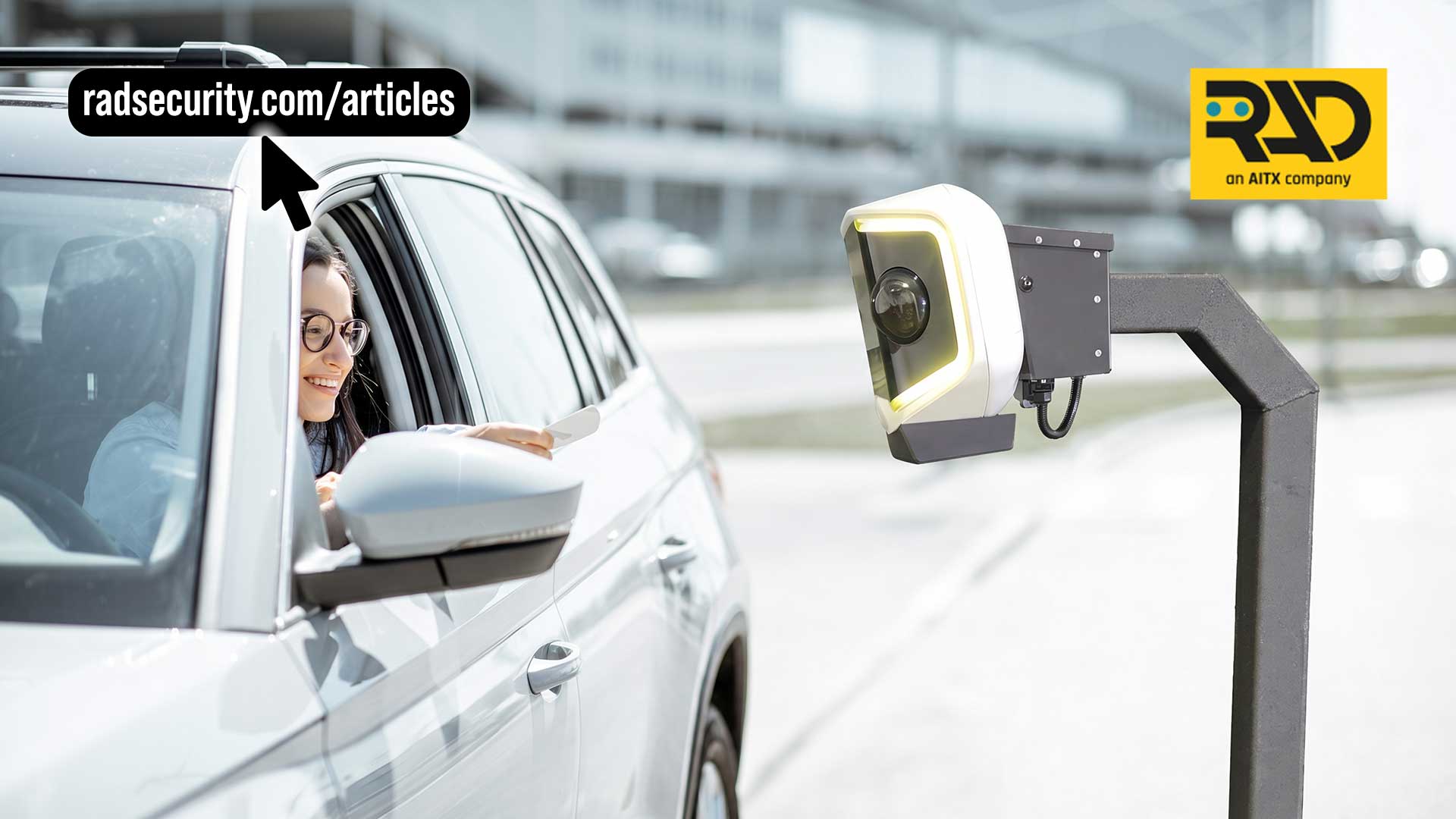
AVA, the Autonomous Verified Access platform, is RAD's gate access control solution. It's the gate-side device that runs this workflow as a single autonomous checkpoint. Dual 5MP PTZ cameras deliver 180 degrees of edge-to-edge visibility across the lane. License plate recognition runs continuously across the approach for the hands-free employee path. A 10-inch RADGuard touchscreen accepts PIN, QR code, barcode, and driver's license inputs for everything else. Anti-tailgating detection covers both vehicles and pedestrians. AVA also integrates with existing security infrastructure at the property, including surveillance cameras, intercom systems, automated sensors, and vehicle detection systems already deployed.
Edge AI Verification Without the Cloud Round-Trip
Credential verification happens locally on an NVIDIA Jetson Orin NX. No cloud round-trip. No waiting on a remote operator to confirm a match. The onboard database holds the active roster, and a 2TB SSD retains the entry record. When the WAN comes back online, everything syncs and centralized management resumes through the RAD operations console.
SARA Handles the Exceptions That Need Judgment
What separates AVA from the half-automated model isn't the credential types. Cloud-native access vendors have QR codes. Security-ops platforms have LPR. Legacy operators have keypads and callboxes. What separates AVA is that all of it runs at the gate, on one device, without dragging the SOC into every credential exception or routing each anomaly to a remote operator by default. AVA manages the physical gate. SARA, the agentic AI orchestration layer, handles the exceptions that genuinely require judgment and documents everything from detection through resolution.
At sites where there's still a booth, AVA replaces it. At sites where there isn't, AVA replaces the radio call. What's left is the security team doing the work that needs a human.
The Line Doesn't Have to Be There
Sequential workflows were the gate access control problem long before the booth was empty. Every visitor became a serial bottleneck. Every exception became a radio call. Autonomous verification through agentic AI makes the process parallel. The credential is issued before the driver arrives. The gate confirms what's already true.
Employees in rental cars stop sitting in the line. Vendor mornings stop backing up onto the cross street. The contractor whose phone died gets through the gate without pulling the supervisor away from the console.
The line is a legacy problem. The fix is no longer hypothetical.