
From Detection to Resolution, a Timeline Legal Can Defend
Six months after an incident, the timeline matters more than the video.
A subpoena lands. Legal asks for the timeline. They want every decision, every handoff, and every action tied to a timestamp. They want to know what happened between first detection and responder arrival, and they want it in a form that holds up under scrutiny.
That request is where security programs get judged. Many teams can produce video and event logs. Far fewer can produce a single, complete response record without rebuilding it from fragments. Phone calls, radio traffic, shift notes, and disconnected system logs don’t add up to an audit trail. They add up to reconstruction.
Reconstruction is slow, inconsistent, and expensive. It also shows up at the worst possible time, when liability, insurance, or regulatory review is already in motion.
2026 is when modern security gets measured by defensible outcomes.
The Execution Gap
Detection is getting better across the industry, and new devices are raising the bar.
The operational constraint shows up after the alert: verification, deterrence, escalation, reporting. That’s where time slips and liability grows, especially at multi-site scale.
The shift for 2026 is simple. Keep improving visibility, but modernize the workflow that turns visibility into resolution.
GSOC Reality at Enterprise Scale
Most GSOCs hit their limit when response stays single-threaded.
An alert fires. An analyst verifies. An analyst decides. Outreach starts. Documentation gets written later if the shift has time. When volume spikes, incidents stack. The queue grows. Decisions get delayed, escalation becomes inconsistent, and follow-through depends on who’s on shift and what else is happening.
Backlog becomes exposure at Fortune 50 scale. A queue signals that the organization had evidence of an event while response capacity lagged behind it. That’s difficult to defend in any executive review, and it’s worse in court.
Staffing ratios don’t solve this. They push costs up, and they still leave the same constraint in place: one person can only run one incident thread at a time.
The KPI That Matters in 2026
Activity metrics are easy to count. Alerts reviewed, cameras online, events acknowledged. They don’t answer the questions leadership asks after an incident.
Time to Resolution does.
Time to Resolution measures the elapsed time between first signal and incident closure, backed by a defensible record. It’s also one of the cleanest bridges between security and the CFO, because delay has a direct cost.
More time to resolve means more dwell time for bad actors, more loss exposure, and longer operational disruption. In logistics and manufacturing, it can translate into delayed shipments, halted lines, missed SLAs, and higher claim frequency. When incidents drag, uptime suffers.
Once you manage to Time to Resolution, the bottlenecks are obvious. Verification can’t drag. Deterrence can’t wait for availability. Escalation can’t rely on phone trees. Documentation can’t live at the end of the process.
When any of those steps stall, resolution stalls.
What “Defensible” Means
A defensible incident record reads like evidence, not a story.
It’s timestamped. It’s complete. It reflects what was known at the time decisions were made. It shows which actions were taken, by whom, and when. It reduces interpretation and strengthens accountability.
That matters across real compliance and liability surfaces. OSHA and safety investigations care about documented response and supervision. SOC 2 and ISO-aligned programs care about control evidence and auditability. C-TPAT cares about access integrity and documented incident handling in supply chain environments. Insurance carriers care about timelines, mitigation actions, and whether controls operated as represented.
A clip and a note won’t carry that weight.
Security Incident Orchestration Becomes the Category
Security incident orchestration is the execution layer that connects detection to closure.
It runs verification, deterrence, escalation, response, and reporting as a controlled workflow across systems and stakeholders. It standardizes what “done” looks like, and it reduces the dependence on manual handoffs.
This is where enforced standardization becomes achievable at scale. Procedures stop living in binders and tribal knowledge. They become workflows that execute the same way across sites, shifts, and teams, with auditability built in.
It also enables automated compliance. Not in the sense of replacing oversight, but in the sense of ensuring required steps happen, required stakeholders get notified, and required documentation is captured every time.
The Labor Delta CSOs Need to See
A traditional alert-to-closure chain forces analysts to do the same manual work repeatedly: open multiple systems, correlate video with access events, draft notifications, run call lists, repeat context across stakeholders, and assemble the incident record after the fact.
Orchestration removes those repetitive touches. The analyst stops acting as a router and starts supervising exceptions and validating outcomes. Work moves from manual execution to oversight and control.
That’s the difference between additive tech and substitutive capability.
Agentic AI, in One Sentence
Agentic AI is AI that can reason through a goal, plan the steps, and take action across systems under defined constraints.
For a CSO, the important part isn’t the label. It’s the constraint model. The organization defines the rules. The workflows execute inside those rules. High-consequence actions remain gated, logged, and human-controlled.
A Concrete Before and After
Picture a group approaching the exterior wall of an industrial site after hours. They’re clustered close to the building, heads down, moving with purpose. The camera sees them, but it’s the worst angle for identity. Hoodies. Faces turned away. Low light.
In the current model, the system records the behavior and the GSOC reviews it after the fact. Even when monitoring is live, the process is still sequential: verify, decide, then act. By the time a human is ready to intervene, the first tag is already on the wall. The footage documents what happened, but it doesn’t prevent it. It also doesn’t always hold up well later, because you can show presence, not identity.
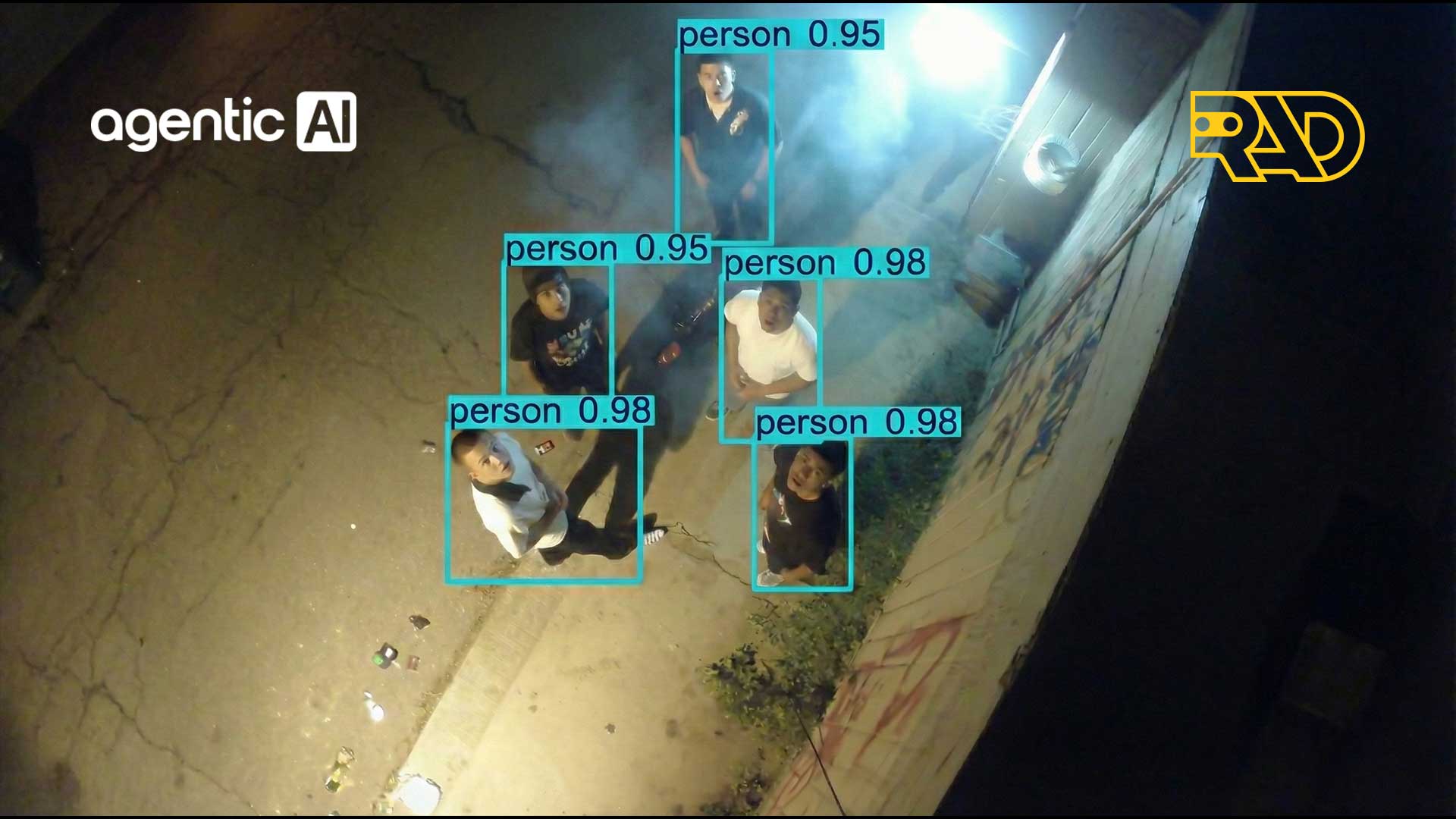
In an orchestrated model, the incident doesn’t wait in a queue. The moment the approach is verified, the response triggers immediately under policy. A descriptive audio talk-down fires in seconds, specific enough to be unmistakable: location, behavior, and direction to leave. That instant intervention is what changes the outcome. It interrupts intent before damage occurs.
It also changes the evidence. People who think they’re unseen keep their heads down. People who realize they’re being addressed tend to look up. The camera gets faces, not just hoodies and backs. The record becomes clearer at the same time the incident is being shut down.
Later, if legal or law enforcement asks what happened, you’re not assembling a story from memory. You have an audit-ready case file: continuous footage, timestamps, the exact talk-down delivered, notification timestamps, actions taken, and time to closure.
That’s the point of orchestration. Fewer completed crimes, faster resolution, and a record that stands up without reconstruction.
Where This Gets Real
RAD’s implementation of that orchestration model is SARA Agentic AI, built to operate in the gap between detection and closure without adding more work to the GSOC.
That’s the 2026 baseline in plain terms: reduce uncertainty fast, take action without waiting in a queue, and produce a record that holds up under scrutiny.
David Marsh Vice President of Marketing Robotic Assistance Devices linkedin.com/in/davidmarsh
To see how SARA Agentic AI carries verified events from detection to resolution, visit radsecurity.com/sara.